
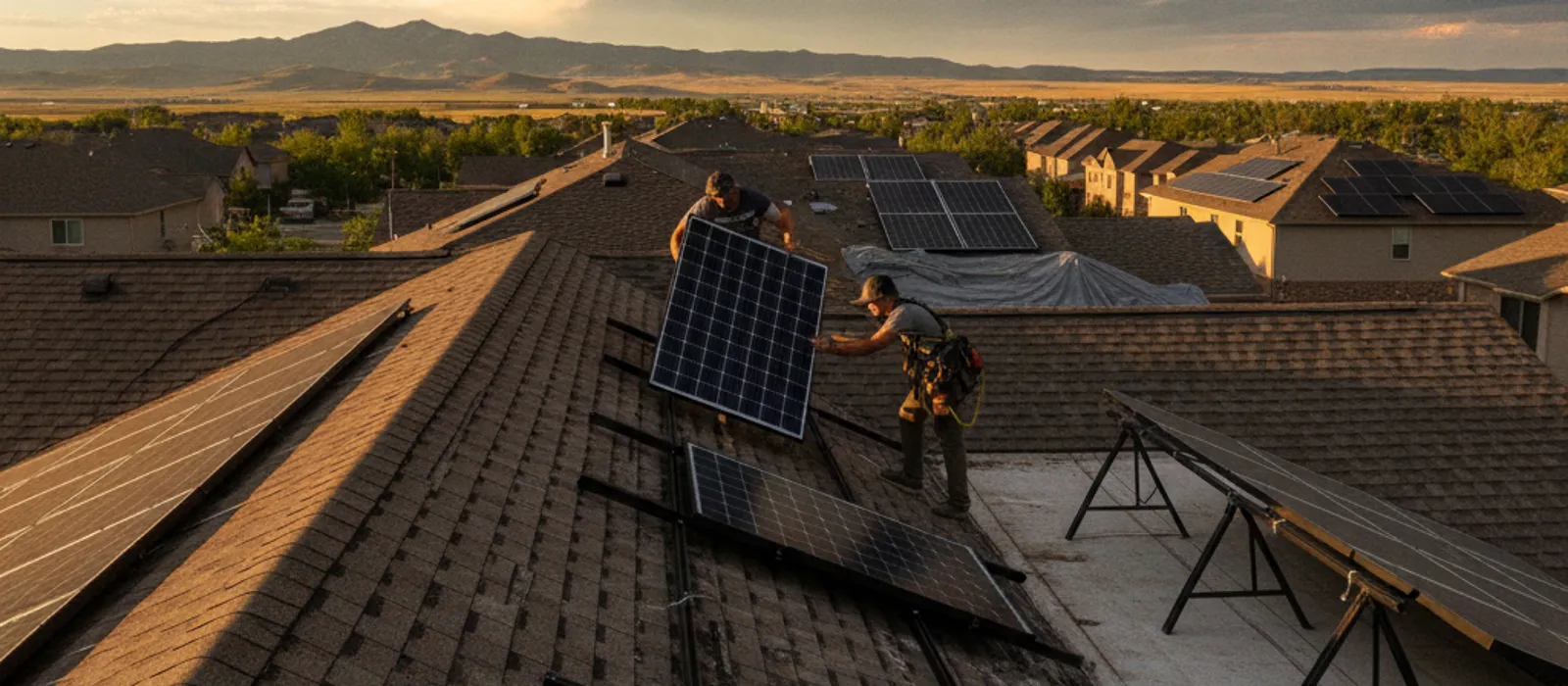
Your roofer just called with good news and bad news. The good news: your hail claim got approved and the crew can start next Thursday. The bad news: somebody has to get those 22 solar panels off your roof first, and it’s not going to be them.
If you’re standing in your kitchen right now wondering what is solar detach and reset, and why your roofing contractor suddenly can’t finish the job without one, you’re in the right place. It’s one of the most common questions we get in Greeley, especially in the weeks after a big hailstorm rolls through Weld County. This guide walks you through the whole thing: what the service actually is, what it costs, how it fits into your reroof timeline, and the mistakes that cost your neighbors real money.
The Short Answer: Panels Off, New Roof On, Panels Back On
A solar detach and reset (sometimes called detach and reset, D&R, or remove and reinstall) is a two-visit service that lets your roofer replace the roof under your solar array.
Here’s the sequence in plain terms:
- Detach. A solar crew shuts down your system safely, disconnects the electrical, unbolts the panels and racking, and stores everything. The roof is now bare and ready for tear-off.
- Roof work happens. Your roofing contractor does their job with nothing in the way. This part isn’t ours, but we coordinate closely with them.
- Reset. Once the new shingles are down, the solar crew comes back, installs new flashed mounts on the fresh roof, reassembles the racking, sets the panels, reconnects the wiring, and powers the system back up.
That third step matters more than most homeowners realize. A reset is not just bolting panels back where they were. Every roof penetration gets new flashing and sealing so your brand-new roof doesn’t leak, and the electrical gets reconnected and tested so your system actually produces power again. If you’ve read our post on roof leaks under solar panels, you know the mounts are where most problems start.
If you’re mid-reroof right now and need this handled fast, reach out for a free written estimate or call us at (970) 286-3417. We work around roofing schedules every week, and we know the clock is ticking on your claim.
Why Your Roofer Won’t Touch the Panels
This surprises a lot of people. The roofing crew is already up there, so why can’t they just pull the panels off?
Two reasons: licensing and liability. Solar panels are part of an electrical system that ties into your main service panel and, in most Greeley homes, back-feeds the grid through your net meter. Disconnecting and reconnecting that system is electrical work. Roofers aren’t licensed for it, and the good ones won’t pretend to be. We wrote a whole piece on whether roofers can remove solar panels if you want the full breakdown.
There’s also your equipment warranty to think about. Most panel and inverter manufacturers require that removal and reinstallation be done by qualified solar technicians. If a roofing laborer cracks a panel carrying it down a ladder, or a connector gets reseated wrong and arcs later, you can end up fighting the manufacturer, the roofer’s insurance, and your own carrier all at once.
Here’s what that looks like when it goes wrong. A homeowner in Windsor, Dana, let her roofing crew “save her some money” by pulling 16 panels themselves last summer. Two panels came off the roof with cracked glass, and the crew stacked the rest face-down on the driveway. By the time a solar company got involved, she was looking at $2,400 in panel replacements and repairs that her roofer’s insurance fought for months. The detach quote she’d turned down was $1,900.
What Does a Solar Detach and Reset Actually Involve?
Let’s get more specific about what you’re paying for, because a proper detach and reset is a lot more than unbolting hardware.
On detach day:
- The crew shuts the system down in the right order: AC disconnect, inverter, then DC isolation. No live conductors while people are working.
- Panels come off one at a time and get inspected, labeled, and stored, either on site or in secure storage if your project needs it.
- Racking and rails come down. Mounting hardware that’s corroded or hail-damaged gets flagged for replacement.
- Wiring is safely capped and protected. If your system has optimizers or microinverters, those get documented panel by panel so everything goes back in the same position.
On reset day:
- New mounts go in with proper flashing integrated into your new shingles. This is the step that protects your roof warranty.
- Rails, panels, and wire management go back up to the original engineering layout.
- The crew torques every connection to spec, reconnects the electrical, and commissions the system.
- You get verification that the system is producing, not just that it turns on. Those are different things, and our post on solar systems staying offline after a roof replacement explains why that final check matters so much.
The inspection piece deserves its own mention here in hail country. If your reroof is happening because of a storm, there’s a decent chance your panels took hits too. A detach is the best possible moment to look, because every panel is in someone’s hands at ground level. The National Weather Service office in Boulder, which covers northern Colorado, tracks our severe hail days each season, and you can see the storm reports for yourself on weather.gov/bou. We’re in one of the most hail-prone corridors in the country. Finding damage during the detach, while your claim is still open, is a lot better than finding it a year later.
How Much Does a Solar Detach and Reset Cost in Northern Colorado?
Most residential detach and reset jobs in the Greeley area land between $2,000 and $5,500 total, covering both visits. Where you fall in that range depends mostly on panel count, roof pitch, system age, and how much of the racking hardware can be reused.
Here’s a realistic picture for our service area:
| System Size | Typical Panel Count | Typical D&R Range | Common Add-Ons |
|---|---|---|---|
| Small (4-6 kW) | 10-16 panels | $2,000 - $3,200 | New flashing kits, storage fees |
| Medium (7-9 kW) | 17-24 panels | $2,800 - $4,300 | Rail replacement, critter guard reinstall |
| Large (10-14 kW) | 25-36 panels | $4,000 - $5,500+ | Steep-pitch labor, electrical upgrades |
| Ground-mount or multi-array | Varies | Custom quote | Trenching checks, multiple inverters |
A few notes on those numbers. First, if your reroof is part of a hail claim, the detach and reset is usually a line item in the insurance scope, so the out-of-pocket hit is often much smaller than the sticker price. We covered how that works in does insurance cover solar detach and reset. Second, quotes vary between companies more than you’d expect, and the cheapest number isn’t always covering the same work.
Real example: Mike in Evans had a 24-panel system and a roof scope from a July storm. His adjuster’s initial estimate included $2,100 for detach and reset. Our written quote came in at $3,450 because his 2015-era racking used a discontinued mount that had to be replaced across the whole array. We documented it, his roofer submitted the supplement, and the carrier paid the difference. Mike’s actual out-of-pocket: his deductible, which he owed anyway. The homeowner two streets over who skipped the documentation ate a $1,300 gap himself.
Want a number for your actual roof instead of a range? Request a free written estimate. It costs nothing, and it’s the document your adjuster will want to see anyway.
Detach and Reset vs. Permanent Removal: Don’t Confuse the Two
These get mixed up constantly, and the difference changes both the price and the paperwork.
A detach and reset assumes the panels are coming back. The system stays yours, the interconnection agreement with your utility stays active, and the goal is minimal downtime.
A permanent removal means the panels come off and stay off. That involves de-registering the system, capping the roof penetrations permanently, removing conduit runs, and often coordinating with your utility to close out net metering. It’s a different job with different costs, and if that’s what you actually need, start with our guide to the cost to remove solar panels permanently.
Where it gets interesting is hail damage. Sometimes a detach turns into a partial replacement, because the ground-level inspection reveals panels that took hits. Frank in Johnstown had us out for a straightforward 18-panel detach ahead of his reroof last fall. During the detach, our crew found shatter patterns on three panels and micro-crack signatures on two more that looked fine from the ground. Because his hail claim was still open, those five panels went into a supplement, and the carrier approved roughly $4,100 in panel replacement on top of the roof scope. If he’d waited until after the claim closed, that money was gone.
That’s why the detach visit doubles as your best inspection opportunity. The U.S. Department of Energy’s homeowner’s guide to going solar is a good primer on how these systems are put together and why panel condition drives production, if you want the background reading.
How the Timeline Fits Around Your Reroof
Here’s the part that stresses homeowners out the most, so let’s lay out a typical Greeley-area schedule:
- 1-2 weeks before roofing: Get your detach and reset scheduled. Good solar crews book out, especially in the weeks after a storm when every roofer in Weld County is slammed.
- Detach day: Usually one day for most residential systems. Your roofer can typically start tear-off the next morning.
- Roofing: However long your roofer needs, usually 1-3 days for asphalt shingles.
- Reset day: One day for most systems, scheduled as soon as the roof passes inspection.
- Back online: Same day as the reset in most cases.
Total solar downtime is typically under a week when the coordination is done right. Every extra day your panels sit in the garage is a day of production you’re not getting back, which matters in July when your system might be generating 40 to 50 kWh a day. If you want the deeper version, we broke down the full schedule in a separate post on how long a detach and reset takes.
The scheduling trap to avoid: booking the roofer first and calling solar companies the week of tear-off. That’s how homeowners end up with a roofing crew standing around, or worse, a crew that decides to move the panels themselves. Loop in your solar crew the same week you sign the roofing contract, and give both companies each other’s contact info. We talk to roofers directly all the time. It makes everything smoother.
And if a storm just hit and you’ve got exposed decking or a panel hanging loose, don’t wait on a schedule at all. Our emergency line runs 24/7 for storm-damage callouts: (970) 286-3417.
When to Stop DIY-ing and Pick Up the Phone
We’re all for homeowners handling what they can. Checking your monitoring app, photographing hail strikes from the ground, and reading your insurance scope line by line are all smart moves you can make yourself.
But the line is bright and clear: don’t put hands on the array. A residential solar circuit can carry lethal DC voltage even when the sun is low and even when the inverter is “off.” Panels are heavy, awkward, and slick, and a two-story fall with a 45-pound sheet of glass in your hands is not a risk that saves you money. Racking bolts also thread into your roof structure, and backing them out wrong turns a simple reroof into a deck repair.
Call a professional when any of these are true:
- Your roofer has given you a start date and the panels are still up.
- You see cracked glass, burn marks, or a panel shifted out of its row after a storm.
- Your monitoring shows zero production or an inverter fault after hail. Our guide to the signs of hail damage on solar panels covers what to look for from the ground.
- An adjuster is coming and you want the array documented before the roof scope is written.
That’s the whole list. Everything on it is a phone call, not a ladder trip.
Frequently Asked Questions
How long does a solar detach and reset take?
Most residential systems come down in a single day and go back up in a single day. The gap between the two visits depends on your roofer’s schedule, but total solar downtime is usually under a week when everyone coordinates. Larger systems, steep roofs, and hail-season backlogs can stretch that.
Does homeowners insurance pay for a detach and reset?
Usually yes, when the reroof itself is a covered claim. The detach and reset appears as a line item in the roof scope, though initial adjuster estimates often lowball it. A written quote from a solar contractor gives your roofer what they need to file a supplement for the difference.
Will a detach and reset void my solar warranty?
Done properly by qualified solar technicians, no. Most manufacturer warranties stay intact when removal and reinstallation follow the installation manual, with correct torque specs and approved mounting hardware. The real warranty risk comes from letting an unlicensed crew handle the panels, which can void coverage on both the equipment and the workmanship.
Can I leave the panels off and reinstall them later?
You can, but plan for storage and downtime costs. Panels need to be stored upright, protected, and dry, and every month offline is production you’re paying the utility for instead. If you’re thinking about leaving them off permanently, that’s a removal job with different steps, including closing out your net metering agreement with the utility.
Greeley Solar Reset provides solar detach and reset, panel removal, and storm-damage service across Greeley, Evans, Windsor, Johnstown, Eaton, Firestone, Fort Lupton, and the rest of Weld and Larimer counties. Free written estimates. Licensed and insured. Call (970) 286-3417 or request an estimate.