
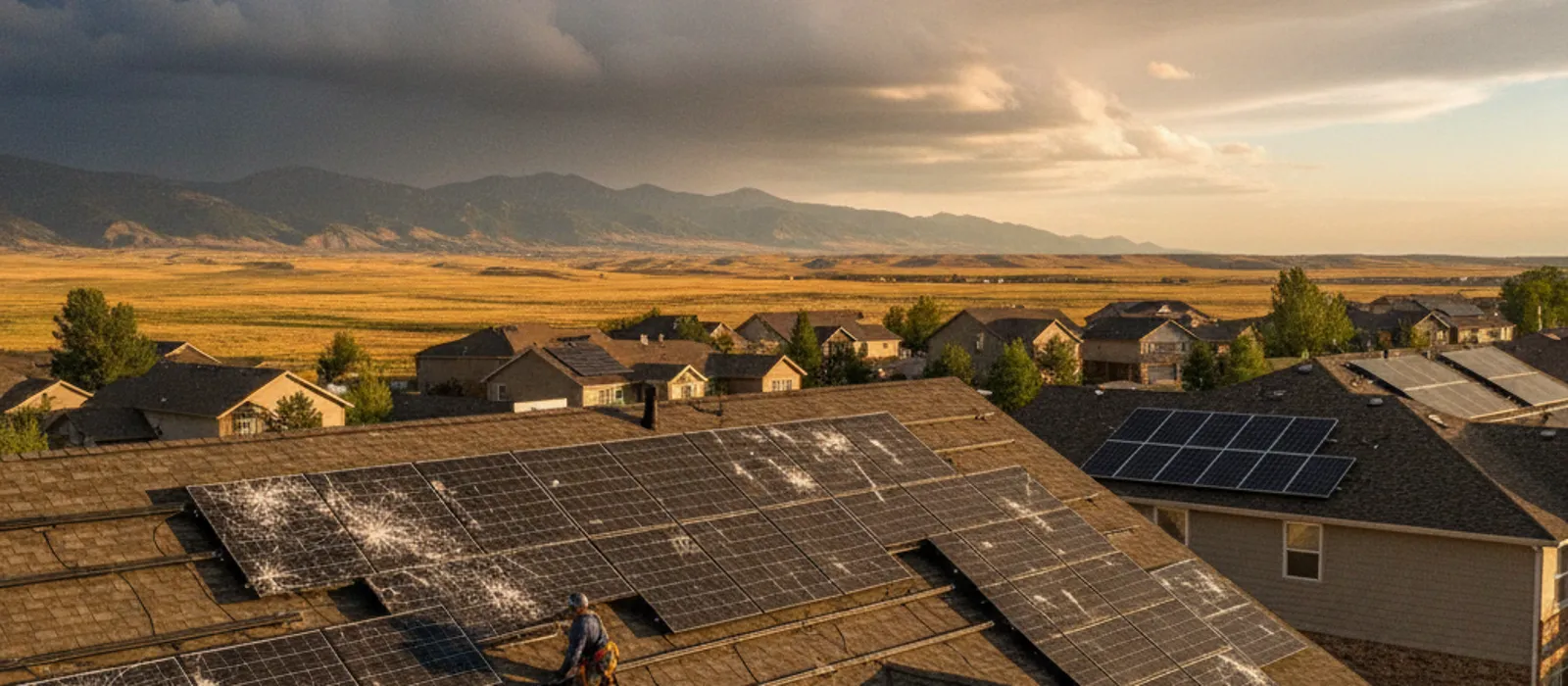
Your roof just took a beating, the gutters are dented, and your neighbor already has a roofer’s sign in the yard. But your solar panels look fine from the driveway, so they’re probably fine, right?
Not necessarily. The signs of hail damage on solar panels are often invisible from the ground, and some of the worst damage never shows up as a crack you can see. Panels can lose 20 percent of their output from internal fractures while the glass looks showroom clean. Here in Greeley and across Weld and Larimer counties, we inspect systems after every major storm, and roughly half the damaged arrays we find looked untouched from the street.
This guide walks you through exactly what to look for, what you can check yourself from the ground, what the repair numbers actually look like, and when it’s time to put the binoculars down and call someone with a harness and a meter.
Why Northern Colorado Hail Is So Hard on Solar Panels
Greeley sits in the middle of what the National Weather Service calls hail alley. The stretch from the Front Range foothills out across the eastern plains sees more large hail than almost anywhere else in the country. You can check storm reports for our area anytime through the NWS Boulder office, which covers Weld and Larimer counties.
Most residential panels are tested to survive 1 inch hail at around 50 miles per hour. That sounds reassuring until you remember what actually falls here. Quarter size hail is a Tuesday. The storms that tear up roofs in Evans, Eaton, and Firestone regularly drop 1.5 to 2 inch stones, and wind-driven hail hits at an angle the lab tests never account for.
There’s a second problem that catches homeowners off guard. If your roof was damaged badly enough to need replacement, your panels have to come off for the reroof anyway. That means a hail claim often becomes two questions at once: are the panels damaged, and who’s going to detach and reset them so the roofer can work? Sorting out panel damage before the reroof starts saves you from paying to reinstall panels that should have been replaced on the insurer’s dime.
If you’re staring at a storm-hit roof right now and need a second set of eyes, call us at (970) 286-3417. Estimates are free and written, and you’ll know where you stand before the adjuster shows up.
Visible Signs of Hail Damage on Solar Panels
Start from the ground with binoculars or a zoomed-in phone photo. Do not get on the roof after a storm. Wet shingles, loose granules, and damaged decking send homeowners to the ER every hail season, and none of what you’re looking for requires being up there.
Here’s what visible damage looks like:
Shattered or spiderwebbed glass. This is the obvious one. Tempered panel glass doesn’t crack in a single clean line. It shatters into a spiderweb pattern radiating out from the impact point, similar to a windshield hit. Even one shattered panel matters, because moisture gets in and corrodes the cells underneath.
Dents or chips at the panel edges. The aluminum frame takes hits too. A dented frame can warp the seal around the glass, which lets water migrate into the laminate over the following months.
Damage to everything around the panels. This is the tell most people miss. If your metal roof vents are dented, your gutters look like a golf ball driving range, and your AC fins are flattened, your panels took the same hits. Hail doesn’t skip the most expensive thing on your roof.
Cracked or drooping conduit and wiring. Look at the exposed conduit runs along the roof edge. Cracked conduit means water reaches wiring, and that’s a problem that grows quietly.
Teresa in Windsor called us two days after the June storm that hammered the Water Valley area. From her yard she could see spiderweb cracks on three panels on the south face. Her insurance adjuster initially scoped only the roof. Because she had clear photos of the shattered glass, the scope got supplemented to include three replacement panels plus detach and reset for the full array. The panel portion alone added $2,850 to her claim, money she’d have eaten herself if she’d assumed the panels were fine.
One important note: a visibly cracked panel sometimes still produces power, which convinces people it’s okay. It isn’t. We cover why in detail in can a cracked solar panel still work, but the short version is that a cracked panel is a slow leak, not a stable condition.
Hidden Hail Damage Signs: Micro Cracks and Hot Spots
Now for the damage you can’t see, which is honestly the bigger risk in our area.
Solar cells are thin wafers of silicon, thinner than a credit card. When hail hits the glass, the glass can flex without breaking while the cells underneath fracture. These micro cracks are invisible to the naked eye. They don’t show on your phone camera. They show up in your production data and, eventually, in physical symptoms.
Watch for these over the weeks after a storm:
A production drop with no other explanation. If your system made 38 kWh on sunny days before the storm and now makes 30 on identical weather, something changed. Compare same-month numbers from last year if your monitoring app keeps history. A drop of 10 percent or more after a hail event is the single most reliable indicator of internal cell damage. We break down the mechanics in solar panel micro cracks from hail.
Hot spots. A fractured cell resists current instead of carrying it, and resistance makes heat. Over time this creates a hot spot, a small area of the panel that runs much hotter than the rest. You might see browning or a burn mark on the backsheet, or discoloration under the glass. Hot spots are a fire risk, not just a performance issue.
Snail trails. These are thin dark lines that appear on the panel surface months after the damage, caused by moisture reacting with the silver in cracked cells. If you see squiggly discolored lines that weren’t there last year, the cracks happened a while ago, often during a storm nobody connected to the panels.
New inverter errors or ground faults. Moisture intrusion from a compromised panel or cracked conduit often trips ground fault errors on the inverter. An error code that appears within days of a storm is worth taking seriously.
Mark in Eaton learned this the expensive way, then the less expensive way. After a golf ball hail storm, his panels passed his own eyeball check and he moved on. Eight months later he noticed his true-up bill from the utility had crept way up. His monitoring showed production down 22 percent year over year. An inspection with a thermal camera found micro crack damage across nine panels. Because he had dated storm photos of his dented gutters and the production history, his insurer accepted the claim even months later. Panel replacement plus the labor came to $9,400, covered minus his deductible. Without that documentation, he’d have been buying nine panels out of pocket.
Check Your Production Numbers Before You Call Anyone
You have a diagnostic tool most homeowners forget about: your monitoring app. Spend ten minutes with it before you call your insurer or anyone else. Documentation you gather now is the difference between a smooth claim and an argument.
Do this:
- Screenshot your daily production for the 30 days before the storm.
- Screenshot the days since the storm.
- If your app shows per-panel output (Enphase and SolarEdge systems usually do), screenshot the panel-level view. One or two panels reading far below their neighbors is a red flag with a location attached.
- Photograph your dented gutters, vents, screens, and AC unit from the ground, with a date stamp.
- Note the storm date and rough hail size. The NWS hail safety page explains how hail size gets reported, and local storm reports back up your date.
Cloudy weeks muddy the comparison, so look at clear-sky days on both sides of the storm date. If the clear-day numbers dropped and stayed dropped, you have evidence, not a hunch.
One thing to be careful about: don’t reset your inverter or clear error codes before someone documents them. A cleared error log is evidence you deleted.
What Hail Damage Inspection and Repair Costs in Weld and Larimer Counties
Numbers vary by system size and roof type, but here’s what homeowners around Greeley, Johnstown, and Fort Lupton are actually paying in 2026:
| Service | Typical Cost Range | Notes |
|---|---|---|
| Ground-based assessment with written report | Free to $150 | Ours is free with a written estimate |
| Rooftop inspection with thermal imaging | $200 to $450 | Finds micro cracks and hot spots |
| Single panel replacement (labor + panel) | $450 to $900 | Depends on panel model availability |
| Detach and reset for reroof (per panel) | $150 to $300 | Full array pricing scales down per panel |
| Full array replacement (avg 20 panels) | $12,000 to $22,000 | Usually an insurance claim, not out of pocket |
| Conduit and wiring repair | $250 to $800 | Often bundled into storm scope |
Two things make these numbers easier to swallow. First, when hail is the cause, most homeowner policies treat panel damage the same as roof damage, so you’re typically looking at your deductible rather than the full figure. We walk through how adjusters handle this in does insurance cover solar detach and reset. Second, if your roof is being replaced anyway, the detach and reset labor is usually part of the roof claim scope, because the roofer can’t work under the array.
Timing matters more than most people realize. Dan in Fort Lupton spotted a burn mark on one panel about a year after a storm he never filed on. By then, connecting the damage to a specific event was nearly impossible, and his claim window arguments went nowhere. He paid $1,200 out of pocket for one panel replacement plus a wiring repair the hot spot had cooked. The same damage documented the week of the storm would likely have cost him nothing beyond his deductible.
If you want the inspection done and documented before your adjuster meeting, request a free written estimate and we’ll put eyes and a thermal camera on it.
When to Stop DIY and Call a Pro
Everything above the roofline is where your part of this job ends. Here’s the honest line between homeowner checks and professional work:
You can safely do this: ground photos, binocular checks, monitoring app screenshots, documenting dents on gutters and vents, noting inverter error codes from the display or app.
Leave this to a licensed pro: anything requiring roof access, opening the inverter or combiner box, disconnecting or testing panels, thermal imaging, and any repair work. Solar arrays carry live DC voltage whenever there’s daylight, even when the system is shut off at the breaker. A damaged array can energize things that shouldn’t be energized, which is exactly when an untrained person on a hail-damaged roof gets hurt.
There’s also a claims reason to bring in a professional early. Adjusters see a lot of roofs and not many solar arrays. A written inspection report with thermal images and production data gives the adjuster something concrete to put in the scope. Homeowners who show up with “the panels look weird” get a very different outcome than homeowners who show up with documentation. The Department of Energy’s research labs have published plenty on how hail affects modules, and NREL, right down the road in Golden, is a good rabbit hole if you want the engineering side.
Our solar hail damage service covers the full sequence: inspection, documentation for your claim, coordination with your roofer, and detach and reset if the roof is coming off. We answer the emergency line 24/7 during storm season at (970) 286-3417, because hail doesn’t schedule itself for business hours.
The short version of this whole article: trust your production data over your eyeballs, document everything the week of the storm, stay off the roof, and get a written inspection before the adjuster writes the scope. Hail damage that’s caught early is an insurance claim. Hail damage that’s caught late is your money.
Frequently Asked Questions
Can hail damage solar panels without cracking the glass?
Yes, and it’s the most common type of damage we find in Northern Colorado. The tempered glass flexes under impact while the thin silicon cells underneath fracture, creating micro cracks that are invisible from the surface. The reliable symptoms are a sustained production drop, hot spots, or snail trails appearing weeks to months later. A thermal imaging inspection is the way to confirm it.
How soon after a hail storm should I check my panels?
Do your ground-level photo documentation and monitoring app screenshots within a day or two of the storm. Then watch your production numbers on clear days over the following two weeks. Insurers are far more receptive when damage is documented close to a dated storm event, so early documentation protects your claim even if you file later.
Will my insurance cover hail-damaged solar panels?
In most cases yes, if the panels are attached to your home and covered under your homeowner policy’s dwelling coverage. Hail damage to panels is generally treated like hail damage to the roof, meaning you pay your deductible and the policy covers the rest. Documentation is what makes or breaks these claims, so gather production data and dated photos before your adjuster visit.
Do my panels need to come off if the roof is being replaced?
Yes, panels have to be fully detached before a reroof and reset afterward, and this labor is commonly included in the roof claim scope. It’s also the ideal moment to inspect every panel up close, because each one gets handled individually. If any panels show hail damage, replacing them during the reset avoids paying for a second round of labor later.