
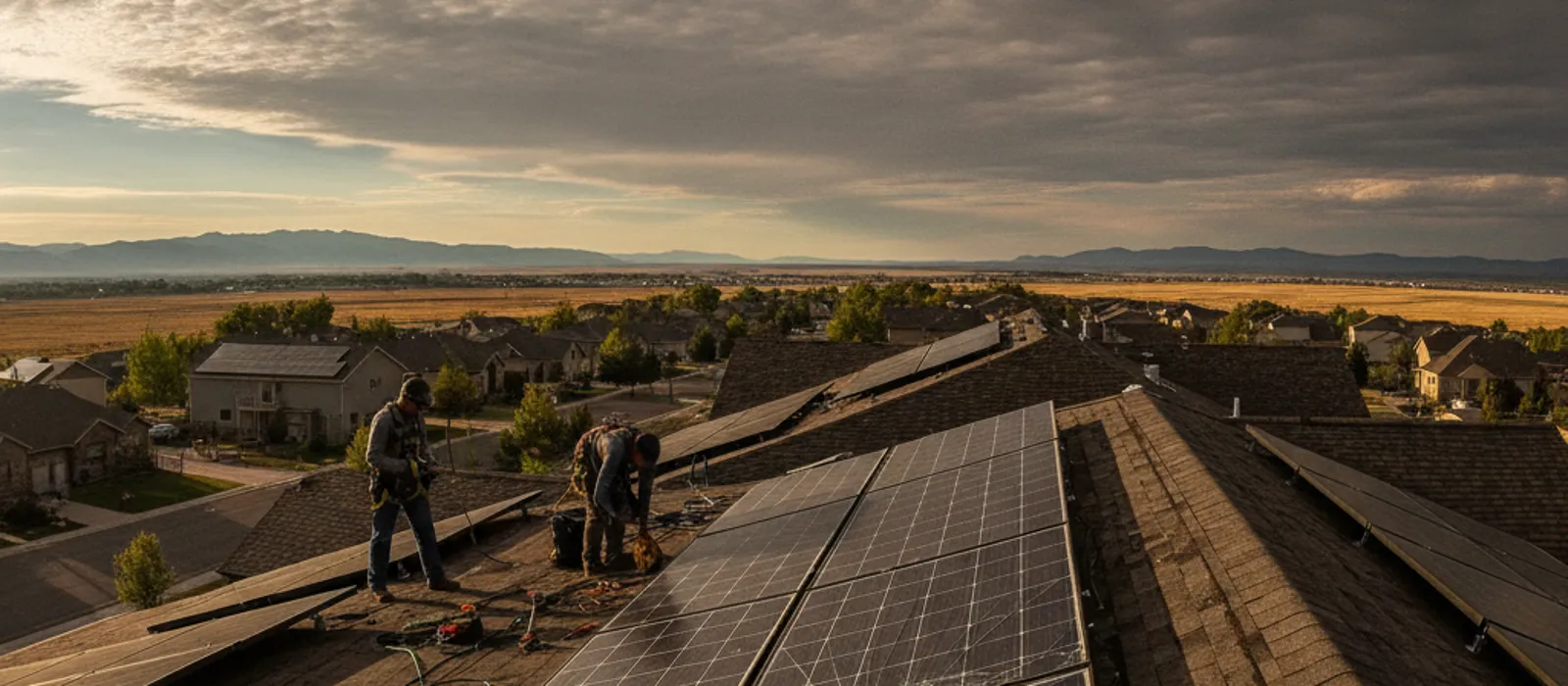
That spiderweb crack across your panel showed up right after last night’s hailstorm, and now you’re staring at your roof wondering if you just lost a $15,000 solar system. Take a breath. So, does a cracked solar panel still work? In most cases, yes, at least for a while. The real questions are how much power it’s still making, whether it’s safe to leave up there, and what it means for your insurance claim if hail did the damage.
We handle solar detach and reset work across Greeley, Evans, Windsor, and the rest of Weld and Larimer counties, and cracked panels come up in almost every hail-season phone call. Here’s the honest breakdown, with real numbers from real jobs.
The Short Answer: Yes, a Cracked Solar Panel Can Still Work
Solar panels are built tougher than most people expect. The cells that actually make electricity sit behind tempered glass and layers of protective encapsulant. A crack in the glass doesn’t automatically kill the circuit underneath.
Plenty of panels keep producing after a crack. Some lose almost nothing at first. Others drop 10 to 30 percent right away, and a few fail completely because the crack ran through the cells themselves or severed an internal connection.
The catch is the word “still.” A cracked panel is a panel on a countdown clock. That crack breaks the weather seal, and northern Colorado weather is exactly the wrong place to test how long a broken seal holds up. Moisture creeps in, freezes, expands, and thaws, over and over. Corrosion starts on the cell contacts. Output slides month by month, and the failure modes that follow are the ones that involve heat and electricity, which is where “still works” stops being good enough.
If you’re looking at a cracked panel right now and you’re not sure how bad it is, send us a photo. Call or text (970) 286-3417 and we’ll give you a straight answer, usually the same day. If your panels cracked during a storm and you’ve got water getting in, our emergency line runs 24/7.
Glass Cracks vs. Cell Cracks: What Actually Broke Matters
Not all cracks are the same, and the difference decides whether you’re losing 2 percent of production or 100 percent.
Glass-only cracks are the ones you can see. Hail hits the tempered glass, and it shatters into that classic spiderweb pattern while staying in place. If the crack didn’t reach the cells, the panel may test at nearly full output the day after the storm. The seal is still broken, though, so degradation is coming. It’s a question of when, not if.
Cell cracks are the sneaky ones. The silicon cells inside a panel are thinner than a credit card, and a hard impact can fracture them without breaking the glass at all. These are called micro-cracks, and you usually can’t see them from the ground or even up close. What you see instead is a production drop on your monitoring app. We wrote a full piece on how hail causes micro-cracks if you want the deeper version.
Cracks through both are the worst case. Visible shattered glass plus fractured cells underneath. These panels usually show an immediate, obvious output loss and they’re the first ones an insurance adjuster will approve for replacement.
Here’s the practical takeaway for a Greeley homeowner: a panel that looks fine can be badly damaged, and a panel that looks terrible can still be producing. Your eyes aren’t the right test. Your production data and an electrical test are.
How Much Power Does a Cracked Solar Panel Still Produce?
It depends on where the crack is and what it touched. Rough ranges we see in the field:
| Damage type | Typical output loss | Safety risk | What to do |
|---|---|---|---|
| Small glass crack, cells intact | 0-5% at first | Low, rising over time | Document it, monitor monthly, plan replacement |
| Spiderweb glass shatter | 5-20% | Moderate | Test the panel, file the insurance claim now |
| Micro-cracked cells (hidden) | 10-30% per panel | Moderate | Electrical testing, check the whole array |
| Crack through cells or busbars | 30-100% | High, hot spot risk | Take it offline, replace the panel |
| Water intrusion behind glass | Falling fast | High | Shut the string down, call a pro |
The loss isn’t always limited to the damaged panel, either. On systems with string inverters, panels are wired in series, and a badly damaged panel can drag down every panel on its string. Dana in Windsor found this out the hard way. One panel took a hail strike, and her monitoring showed the whole 10-panel string down about 30 percent. That worked out to roughly $35 a month in lost production. The fix was one $780 panel replacement, and the string came right back.
The other thing to know is that even healthy panels lose a little output every year, about half a percent annually according to research from the National Renewable Energy Laboratory here in Colorado. A cracked panel degrades far faster than that baseline, which is exactly the argument you make to an insurance adjuster who says “but it’s still producing.”
If your production numbers dropped after a storm and you can’t tell which panel is the problem, we can test the array panel by panel. Request a free written estimate and we’ll put actual measurements on paper you can hand to your adjuster.
When a Cracked Solar Panel Becomes a Safety Problem
Here’s the part that matters more than lost kilowatt-hours. A cracked panel isn’t just a weaker panel. Under the wrong conditions it becomes an electrical hazard on top of your house.
Hot spots are the big one. When some cells in a panel are damaged and others aren’t, the healthy cells can push current through the damaged area, which turns that spot into a little resistor. Resistors make heat. We’ve measured hot spots well over 200 degrees Fahrenheit on damaged panels. Left long enough, they scorch the backsheet and, in rare cases, start fires. We covered the mechanics in our post on solar panel hot spots.
Rick in Eaton called us about a “weird brown mark” on the back of a panel his roofer spotted during a reroof estimate. That mark was a hot spot burn on a panel that had been cracked in a hailstorm two summers earlier and left in service because “it still worked.” The panel got replaced for $1,150 including labor, and honestly he was lucky the damage stopped at one panel.
Water intrusion is the second hazard. Cracked glass lets moisture reach live electrical components. That can cause ground faults, corroded connections, and arc faults, which is the failure mode fire marshals worry about. If you see moisture, fogging, or discoloration inside the glass, that panel should come offline.
What’s safe for you to do yourself: look at your panels from the ground with binoculars, check your monitoring app, and photograph everything. That’s it. Don’t get on the roof after a hailstorm, don’t touch cracked glass, and don’t unplug panel connectors yourself. Those panels produce lethal DC voltage any time light hits them, cracked or not, and there’s no off switch at the panel. This is genuinely a call-a-professional situation, and we mean any qualified solar tech, not just us.
The U.S. Department of Energy has a solid plain-language explainer on how photovoltaic cells work if you want to understand what’s happening inside that glass.
What a Cracked Panel Costs to Fix in Northern Colorado
First, clear one thing up: cracked solar panels don’t get repaired. There’s no resealing a shattered tempered-glass panel, and nobody reputable will offer to. A cracked panel gets replaced, and the money questions are what replacement costs and who pays.
Typical numbers we see across Weld and Larimer counties:
- Single panel replacement: $600 to $1,200 installed, depending on panel model and roof access
- Matching discontinued panels: add $100 to $300, because a panel from 2019 often isn’t made anymore and the closest match costs more
- Electrical testing and inspection: $150 to $400 for a full array checkup
- Full array replacement after major hail: $10,000 to $25,000+, usually an insurance claim
Here’s where it connects to your roof. If hail cracked your panels, it almost certainly hammered your shingles too, and most cracked-panel jobs we do are part of a bigger reroof. That means a solar detach and reset, where the panels come off, the roofers do their work, and the panels go back up, minus any panels the insurance scope replaced.
Marcus in Evans is a good example of how this plays out when it goes right. Golf-ball hail in May cracked six of his twenty panels and totaled his shingle roof. His insurer initially scoped only the roof. We tested the array, documented the six cracked panels plus two more with hidden cell damage, and his adjuster approved a supplement. Final scope: $11,400 for eight replacement panels plus the detach and reset labor, on top of the roof itself. His out-of-pocket was his deductible. Without the testing report, he’d have eaten the panel cost or left damaged panels in service.
Timing matters here. Most homeowner policies want storm damage reported within a year, and some scopes get harder to supplement once the roof work is closed out. If you suspect hail damage on your solar panels, get it documented before the roofing claim wraps up, not after.
What to Do Right Now if Your Panel Is Cracked
Keep it simple. Here’s the order of operations we give every caller:
- Photograph everything from the ground. Wide shots of the array, close-ups of visible cracks with a zoom lens or binocular phone shots. Date-stamped photos are claim gold.
- Screenshot your production data. Grab the last 12 months from your monitoring app so you have a clean before-and-after baseline.
- Check for active hazards. Burning smell, visible moisture inside a panel, scorch marks, or breakers tripping mean you shut the system down at the labeled disconnect and treat it as urgent.
- Get the array tested. Visual inspection alone misses micro-cracks. An electrical test finds the damaged panels your eyes can’t.
- Loop in your insurance before you sign anything. Cracked panels from hail are usually covered under your homeowner policy, and the testing report is what turns “maybe” into an approved line item.
One thing not to do: don’t let anyone talk you into leaving obviously cracked panels in service to “save the claim money.” You’d be trading a covered replacement today for an uncovered failure, and possibly a hazard, two years from now.
Whether you’ve got one cracked panel or a whole array full of spiderwebs, we’ll tell you what’s actually damaged, what’s worth claiming, and what it’ll cost in writing. Call (970) 286-3417 or request your free written estimate. Estimates are free, we’re licensed and insured, and if water is actively getting into your system, the emergency line answers around the clock.
Frequently Asked Questions
Is it safe to leave a cracked solar panel on my roof?
Short term, usually, if there’s no moisture intrusion, scorching, or burning smell. Long term, no. The broken seal lets water reach live components, and damaged cells can develop hot spots that run hot enough to scorch the panel. Get it tested promptly and plan on replacement rather than leaving it up there indefinitely.
Will my insurance pay for a cracked solar panel?
If hail or wind caused the crack, homeowner policies in Colorado typically cover panel replacement, often as part of the same claim as your roof. The key is documentation: dated photos, production data, and an electrical test report showing which panels are damaged. See our full breakdown of how insurance handles detach and reset claims.
Can a cracked solar panel be repaired instead of replaced?
No, not in any way worth paying for. The tempered glass and encapsulant are factory-laminated, and once that assembly cracks, there’s no field repair that restores the weather seal or the warranty. Replacement is the only real fix, and single-panel swaps typically run $600 to $1,200 installed in our area.
How do I know if my panels have hidden damage after hail?
Watch your monitoring app for production drops compared to the same month last year, and get an electrical test if the numbers look off. Micro-cracked cells often show no visible damage at all. Our guide to the signs of hail damage on solar panels walks through exactly what to look for from the ground.