
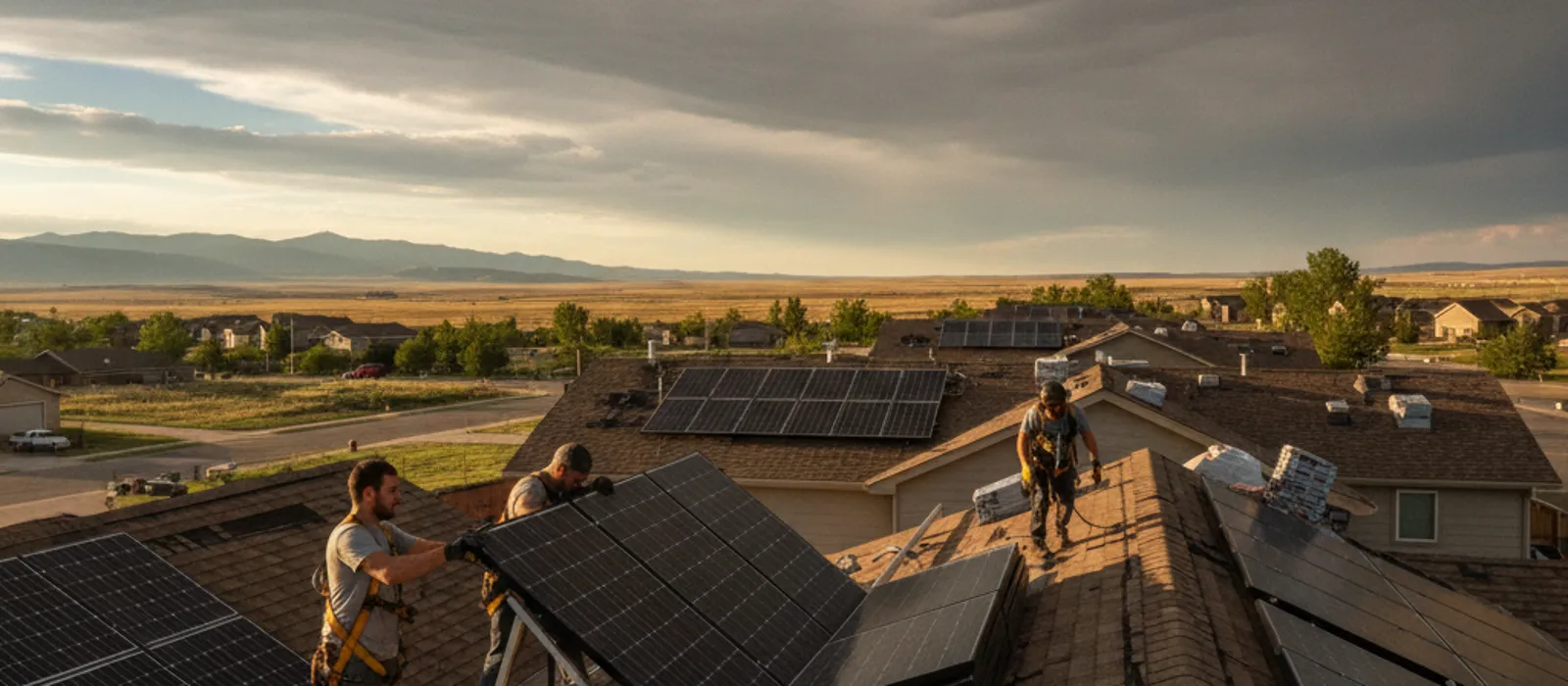
Your roofer just walked the roof, shook your hand, and said the words every solar homeowner dreads: “Those panels have to come off before we can start.” Now you’re wondering who pays for that, because it sure wasn’t in the number you had in your head.
Here’s the good news. If you’re asking “does insurance cover solar panel removal for roof replacement,” the answer in most Northern Colorado hail claims is yes. When your roof damage is a covered loss, the cost to detach and reset your solar panels is usually part of that same claim. The panels have to come off for the roofer to do the job, so insurers treat removal and reinstallation as a necessary cost of the repair.
That’s the short version. The longer version matters, because “usually covered” is not the same as “automatically covered.” Adjusters miss it, first scopes leave it out, and homeowners who don’t push back end up eating $2,000 to $6,000 they never owed. Let’s walk through how it actually works up here in Weld and Larimer counties.
The Short Answer: Covered When the Roof Loss Is Covered
Homeowners insurance covers your dwelling against named or open perils, and hail is a covered peril on nearly every Colorado policy. When hail totals your shingles and the carrier approves a roof replacement, everything reasonably required to complete that replacement belongs in the claim scope.
Solar panels sitting on the damaged roof are an obstruction to the repair. You can’t tear off and re-deck a roof with 20 panels bolted to it. So the labor to detach the panels, store them safely, and reset them on the new roof is a legitimate line item, the same way detaching and resetting a satellite dish or swamp cooler would be.
The industry term for this is detach and reset, sometimes written as D&R on adjuster scopes. If you want the full picture of what the work involves, our guide to what solar detach and reset actually is breaks down the whole process step by step.
Two things have to be true for coverage to apply:
- The underlying roof damage is a covered loss under your policy.
- The removal is necessary to complete the covered repair.
A hail-damaged roof in Greeley checks both boxes. A roof you’re replacing just because it’s 25 years old and tired checks neither, and we’ll get to that below.
If you’re mid-claim right now and not sure whether your scope includes the solar work, send us the scope and we’ll take a look. We read these documents every week and we’ll tell you straight whether the D&R line is there, missing, or priced too low. You can also call us at (970) 286-3417.
When Insurance Covers Solar Panel Removal for a Roof Replacement
The cleanest version of this claim looks like the one Dan ran in Windsor last summer. Hail came through in June, his roofer confirmed the shingles were done, and the adjuster approved a full replacement. Dan has a 22-panel system, and the first scope the carrier sent had exactly zero dollars for solar.
That’s not unusual. First scopes miss solar constantly, especially after a big storm when adjusters are writing 15 roofs a day. Dan’s roofer flagged it, we wrote a detach and reset estimate for $4,300, and the roofer submitted it as a supplement. The carrier approved it in about two weeks. Dan paid his deductible once, on the whole claim, and the solar work was folded into the total.
That’s the pattern that works:
- The roof loss is approved as a covered claim.
- A written solar detach and reset estimate goes in as a supplement if the scope missed it.
- The carrier pays the line item as part of the roof replacement.
A supplement is just a documented request to add necessary costs the original scope left out. It’s routine. Roofers file them for missed flashing, extra decking, and code items all the time. Solar D&R is no different, it’s just a bigger number, so carriers want to see a real estimate from a company that actually does the work.
One more thing worth knowing: the same storm that wrecked your shingles may have damaged the panels themselves. Hail damage to solar panels is often subtle, and it’s worth checking before the system goes back on a brand new roof. Our post on the signs of hail damage on solar panels covers what to look for, and our solar hail damage inspection service can document it for your claim while the panels are already down.
Where Homeowners Get Shorted on Solar Removal Claims
Coverage existing on paper and money landing in your bank account are two different things. Here’s where it goes sideways.
The scope leaves solar out entirely. This is the most common miss. The adjuster writes the roof, notes “solar array present,” and moves on. If nobody supplements, nobody pays. You have to ask.
The scope includes a lowball number. Maria in Evans had a 16-panel system and her carrier’s first scope allowed $1,100 for detach and reset. That’s not a real number for 16 panels with rail removal, safe storage, new flashing at every mount point, and a full electrical recommission. Her actual cost was $2,900. We put the estimate in writing with a line-by-line breakdown, her roofer submitted it, and the carrier paid the difference. If she’d taken the first number, she’d have been out $1,800 for no reason. Scope pricing varies a lot between estimates, and our post on why solar detach and reset quotes vary explains what drives the spread.
The roofer says they’ll handle it, then subcontracts it badly. Kurt and Lisa in Johnstown had a roofer who quoted the solar work at $5,600 through an out-of-town sub, roughly $1,800 above the going rate for their 18-panel system. Worse, the sub had no plan for recommissioning the system with the inverter manufacturer. They got a second quote from us at $3,800, their carrier paid it without a fight, and their system was back online the day after the roof was done. The lesson: get the solar number from a solar company, not as a pass-through markup.
The claim mixes covered and non-covered work. If the carrier approved the back slope but you’re paying out of pocket to redo the front, expect the D&R to be split proportionally. That’s negotiable, but you need to see it coming.
What Detach and Reset Costs, and What Insurance Typically Pays
Real numbers help you sanity-check your scope. Here’s what full detach and reset typically runs in Greeley, Evans, Windsor, Johnstown, Eaton, Firestone, and Fort Lupton, and how carriers usually treat each piece.
| Scope item | Typical cost range | Usually covered on a hail claim? |
|---|---|---|
| Detach and reset, 10 to 15 panels | $1,800 to $3,200 | Yes, as part of the roof scope |
| Detach and reset, 16 to 24 panels | $2,800 to $4,800 | Yes, as part of the roof scope |
| Detach and reset, 25+ panels or steep/two-story roof | $4,500 to $7,500 | Yes, with documentation |
| New flashing and mounting hardware at each attachment point | $300 to $900 | Yes, required to reset on a new roof |
| Panel storage during the reroof | Often included, or $200 to $500 | Yes, if itemized |
| Electrical disconnect and recommissioning | Included in D&R from a qualified company | Yes, part of necessary labor |
| Upgrading or relocating the array while it’s down | Varies widely | No, that’s an improvement |
| Replacing hail-damaged panels themselves | $200 to $400+ per panel installed | Sometimes, as separate contents/dwelling item if damage is documented |
A few notes on that table. The per-panel math gets cheaper as systems get bigger, because mobilization and electrical work are fixed costs. Steep roofs, tile, and two-story homes push the number up. And carriers will pay reasonable storage and recommissioning costs when they’re itemized, but they can’t approve lines that were never written down.
The panel replacement row deserves its own sentence. Removal labor rides on the roof claim, but damaged panels are their own damage item, and you’ll need photos and often an electrical performance test to get them paid.
If you just want a real number for your own roof, request a free written estimate. It costs nothing, it’s the exact document your roofer needs for the supplement, and it’s the fastest way to find out if your scope is short.
How to Get Solar Panel Removal Covered on Your Roof Claim
Here’s the sequence that keeps the solar money in your claim instead of your checkbook.
1. Read your scope before you sign anything. Search it for “solar,” “PV,” “detach,” or “D&R.” If it’s not there, it’s not paid. The Colorado Division of Insurance has plain-language guidance on your rights during the claims process at doi.colorado.gov, and it’s worth ten minutes of your time.
2. Get a written detach and reset estimate from a solar company. Not a verbal ballpark from your roofer. A line-item estimate on company letterhead is what adjusters can actually approve.
3. Have your roofer submit it as a supplement. Roofers file supplements constantly and most are glad to include a clean solar estimate, because it unblocks their schedule.
4. Time the work with the reroof. Panels come off a day or two before tear-off and go back on right after final inspection. Done right, your system is down for about a week. Solar detach and reset is the core of what we do, and our Greeley detach and reset service is built around roofers’ schedules for exactly this reason.
5. Keep the paper. Photos of the array before removal, serial numbers, the estimate, the invoice, and the recommissioning confirmation. If anything gets questioned later, paper wins.
One safety note, and we mean it. Do not try to save the D&R money by pulling panels yourself, and don’t let a general laborer do it either. A residential array is a live DC electrical system, and the disconnect sequence matters. Between the electrical risk, the fall risk, and the warranty you’d void, this is a job for licensed pros. The Department of Energy’s homeowner solar guide at energy.gov is blunt about leaving system work to qualified installers, and so are we.
What Insurance Won’t Pay For
Fair is fair, so here’s the other side of the ledger.
Non-covered reroofs. If you’re replacing the roof because it’s old, because you’re selling, or because you want a different look, that’s maintenance, not a loss. The detach and reset comes out of your pocket. It’s still worth doing right, and we’re happy to quote it, but no carrier owes it.
Upgrades while the panels are down. New panels, more panels, a relocated array, new rail systems you wanted anyway. Insurance restores you to where you were before the storm. Anything beyond that is on you, though mid-reroof is honestly the cheapest time to do it since the labor is already mobilized.
Wear and tear on the solar equipment. A failing inverter or degraded panels that predate the storm won’t ride along on the hail claim.
Your deductible. Colorado roofs commonly carry percentage deductibles now, often 1 to 2 percent of dwelling coverage. On a $450,000 dwelling, a 1 percent deductible is $4,500 off the top of the whole claim, solar included. Coverage doesn’t mean free.
Sloppy removals by unqualified crews. If a roofing laborer cracks a panel prying it off, that’s a liability fight, not a claim item. This is a big part of why roofers generally shouldn’t remove solar panels themselves.
None of this changes the headline. On a legitimate hail claim, which is most of the reroofs happening in Weld and Larimer counties in any given year, the solar removal and reinstallation belongs in your scope, and carriers pay it when it’s documented.
If you’re staring at a scope right now trying to figure out what’s missing, call us at (970) 286-3417. We answer, we’re local, and the estimate is free and in writing. If a storm just hit and your system is throwing errors or your roof is open, our emergency line runs 24/7.
Frequently Asked Questions
Does homeowners insurance cover solar panel removal if I’m replacing my roof due to age?
No. Coverage applies when the roof replacement is itself a covered loss, like hail or wind damage. If you’re reroofing for age, appearance, or a home sale, the detach and reset is an out-of-pocket cost, typically $1,800 to $7,500 depending on system size and roof difficulty.
Do I pay a separate deductible for the solar removal part of the claim?
No. The detach and reset is a line item inside your roof claim, so one deductible applies to the whole thing. On Colorado policies with percentage deductibles, that single deductible can be several thousand dollars, but it isn’t charged twice.
What if the adjuster’s scope doesn’t mention my solar panels at all?
That’s common and fixable. Get a written detach and reset estimate from a qualified solar company and have your roofer submit it as a supplement to the carrier. Carriers routinely approve these because the panels physically have to come off for the covered repair to happen.
Will insurance also pay for panels the hail damaged?
Often yes, but it’s a separate damage item from the removal labor, and it needs its own documentation. Photos, serial numbers, and sometimes electrical testing are required, since hail damage to panels can be invisible from the ground. Having the panels inspected while they’re already down for the reroof is the cheapest time to find out.