
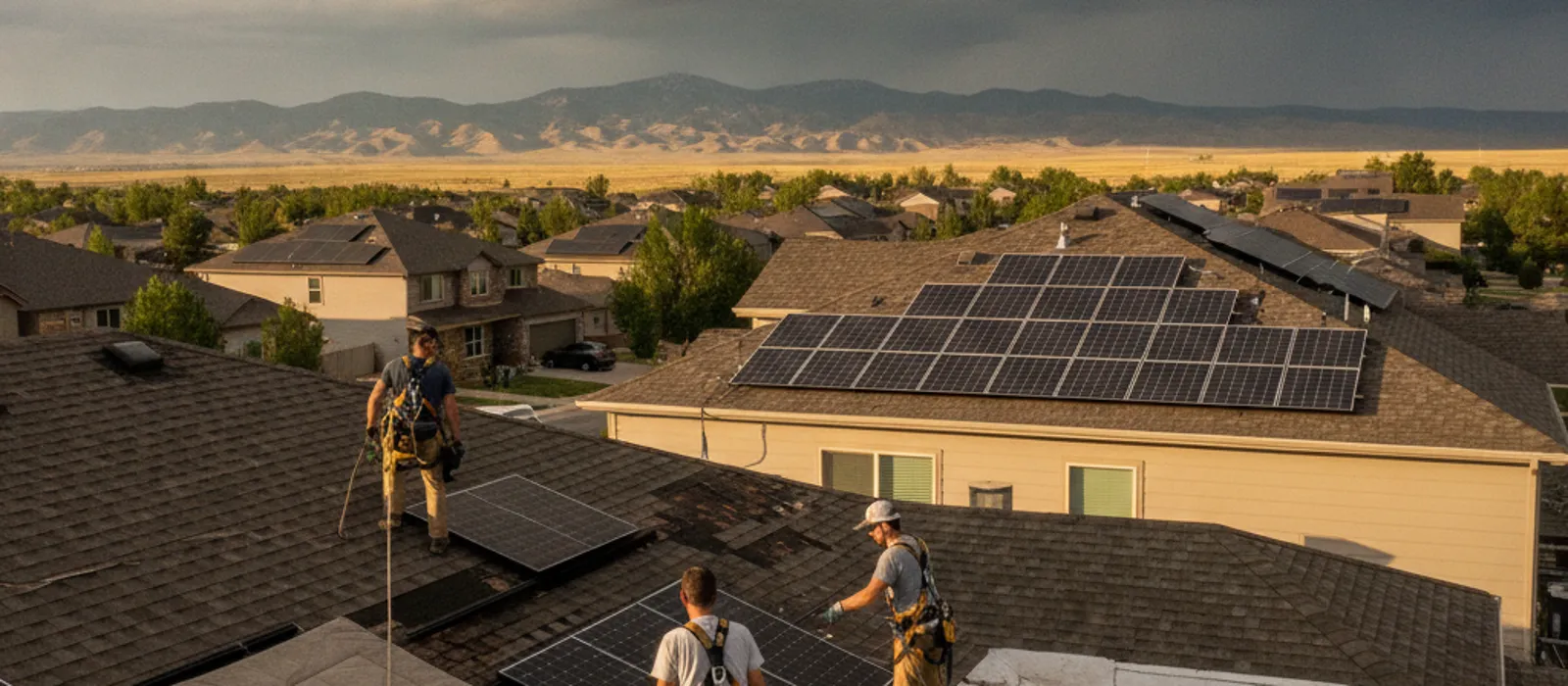
Three quotes for the same 22-panel roof. $2,900. $4,800. $7,400. Same panels, same house, same week, and the homeowner in Greeley had no idea which number to trust.
If you’re mid-reroof and staring at a spread like that, you’re not alone. Solar detach and reset quotes vary more than almost any other line on a roofing project, and it’s rarely because one company is greedy and another is generous. The numbers differ because the quotes describe different jobs. One includes permits, storage, and recommissioning. Another covers lifting panels off and setting them back down, and nothing else.
That gap matters because the stuff the cheap quote leaves out doesn’t disappear. It shows up later as a surprise invoice, a dead system nobody turns back on, or a voided warranty. This article walks through why the numbers swing so hard, what a complete quote actually contains, and how to compare bids without a spreadsheet degree.
If you’d rather just talk it through with someone local, call us at (970) 286-3417 or request a free written estimate. We’ll tell you what your system needs even if you don’t hire us.
Why Solar Detach and Reset Quotes Swing by Thousands
Start with the basic math. Most detach and reset work in Northern Colorado prices out somewhere between $100 and $300 per panel for the full round trip. On a 22-panel system, that’s a range of $2,200 to $6,600 before anyone has even looked at your roof. The per-panel rate moves based on a handful of real factors.
Roof pitch and height come first. A walkable single-story ranch in Evans is a different job than a steep two-story in Windsor with panels over a garage cutout. Steeper roofs mean more safety rigging, slower work, and more crew hours.
System design matters just as much. String inverters, microinverters, and power optimizers each change how the system gets shut down, labeled, and rewired. Older systems with brittle wiring or discontinued rail hardware take longer and sometimes need replacement parts that have to be sourced.
Then there’s what happens between removal and reinstall. If your roofer finishes in two days, panels might stay on site under tarps. If the reroof drags for three weeks waiting on materials, someone has to store your panels safely, and that storage should show up in the price. The U.S. Department of Energy’s homeowner’s guide to going solar is a useful primer on how these systems are put together, which helps explain why taking one apart isn’t a simple lift-and-shift.
Mike in Evans lived this exact spread last spring. His three bids for a 24-panel system came in at $2,800, $4,600, and $7,200. When he asked each company what was included, the $2,800 bid covered removal and reinstall only. No permit, no storage, no inspection, no restart. The $4,600 bid covered everything, in writing. The $7,200 bid was from a solar installer two hours away pricing in windshield time. He took the middle bid and the final invoice matched it to the dollar.
The Line Items a Fair Quote Should Spell Out
A complete detach and reset quote reads like a checklist, not a single mystery number. Here’s what the work actually involves, and roughly where each piece lands on a typical Weld or Larimer County home.
| Line item | What it covers | Typical range |
|---|---|---|
| System shutdown and de-energizing | Safe disconnect, lockout, labeling circuits | $150 to $400 |
| Panel removal and racking teardown | Detaching modules, rails, and mounts | $60 to $120 per panel |
| Storage and protection | Padded stacking, tarping or off-site storage | $0 to $500 |
| Reinstall on new roof | Setting rails, flashing mounts, re-mounting panels | $60 to $150 per panel |
| New flashings and hardware | Fresh sealant, flashing, replacement bolts | $200 to $600 |
| Electrical reconnection | Rewiring, torque checks, grounding | $250 to $700 |
| Permit and inspection | Local electrical permit, inspection scheduling | $150 to $500 |
| Recommissioning | System restart, monitoring check, production test | $150 to $400 |
Add that up and a legitimate quote on a 20-something panel system lands in the $3,000 to $6,500 neighborhood for most homes around here. If a bid comes in way under that, something on this list isn’t in it. If it comes in way over, ask what’s driving it. Sometimes there’s a good reason, like a ground-mount conversion or damaged racking. Sometimes there isn’t.
One more thing a fair quote includes: proof of licensing and insurance. In Colorado, electrical work on your solar system should involve a licensed electrician, and you can verify a license through the Colorado Department of Regulatory Agencies. A company that hesitates to show you a license number and a certificate of insurance has answered your question already.
What the Cheap Quote Usually Leaves Out
The lowball bid isn’t always dishonest. Sometimes it’s just narrow. But the homeowner pays for the gap either way.
Carla in Windsor took a $2,200 quote for her 18-panel system because it beat the next bid by $1,700. The crew showed up, pulled the panels, stacked them in the garage, and left. After the reroof, they set the panels back and drove off. No permit was pulled, no inspection happened, and nobody turned the system back on. Her monitoring app sat dark for five weeks before she noticed.
Getting it fixed cost her another $1,400. An electrician had to pull a retroactive permit, correct two grounding issues the inspector flagged, and recommission the system. Her “cheap” job ended up costing $3,600, which was almost exactly the bid she’d turned down, plus five weeks of lost production during peak summer sun.
The most common gaps in a stripped-down quote are the permit, the inspection, new flashings at every mount point, and the restart. That last one bites more people than you’d think. We wrote a whole piece on why systems stay offline after a roof replacement because it happens constantly, and it’s almost always a handoff nobody priced.
Watch for warranty language too. If the company touching your panels isn’t qualified to do the work, you can jeopardize your panel or inverter warranty. A fair quote names who’s doing the electrical work and states that the reinstall follows the manufacturer’s mounting specs.
Not sure what your current bids actually cover? Send them our way through the contact form and we’ll give you a straight read, free, in writing.
How Hail Claims Change the Detach and Reset Math
Around Greeley, a lot of reroofs start with a hailstorm, and insurance changes how quotes get built. When your roof claim includes solar, the detach and reset is usually a line item in the adjuster’s scope. The question is whether that line item matches reality.
Dan and Priya in Eaton had a June storm total their shingles. The initial insurance scope allowed $1,900 for solar detach and reset on their 26-panel system. Every real bid they collected came in between $4,200 and $5,100. That gap isn’t unusual, because scope software often prices solar R&R with generic labor rates that don’t reflect an actual crew, permit, and recommissioning.
The fix was a supplement. Their contractor submitted the detailed detach and reset quote with per-panel pricing, permit fees, and the recommissioning line broken out, and the carrier revised the allowance to $4,480. They paid their deductible and nothing more for the solar work. A vague one-line quote would have made that supplement much harder to win.
So if you’re in a claim, get quotes that itemize. Adjusters approve documented line items far more readily than round numbers. We cover the insurance side in detail in does insurance cover solar detach and reset, and if hail hit your panels themselves, read up on the signs of hail damage on solar panels before anything gets reinstalled. Resetting a cracked panel onto a brand-new roof is the kind of mistake you only make once.
How to Compare Solar Detach and Reset Quotes Fairly
Comparing bids only works when you force them onto the same footing. Here’s the process that actually protects you.
First, make every bidder answer the same six questions in writing. Who pulls the permit? Who stores the panels and where? Are new flashings and hardware included at every mount? Who does the electrical reconnection, and are they licensed? Who recommissions the system and verifies production? What happens if a panel gets damaged during the work?
Second, ask for per-panel pricing plus fixed costs, not one lump sum. A lump sum hides the gaps. Per-panel pricing lets you spot that one bid includes $500 of permit and inspection work and another includes zero.
Third, check the schedule coordination. Detach and reset lives or dies on timing with your roofer. A fair quote says how much notice the crew needs, how fast they can return after the roof is done, and what a delay costs. Every day your panels sit in a garage is a day of production you’re not getting back. If you want a sense of realistic timelines, we broke them down in how long a detach and reset takes.
Fourth, confirm the company does this work as a core service. Some roofers offer to handle panels themselves to keep the job simple, and that can go badly for reasons we’ve covered elsewhere. Solar-specific experience shows up in the questions they ask you: inverter brand, monitoring platform, rail type, attic access. If nobody asked, be careful.
Our detach and reset service in Greeley is built around exactly this checklist, and our cost guide for panel removal and reinstall walks the numbers in more depth if you want to pressure-test a bid tonight.
Red Flags That Should End the Conversation
A few things justify walking away no matter how good the price looks.
No written quote is the big one. If the number lives in a text message or a phone call, it isn’t a quote, it’s a guess you can’t hold anyone to. Free written estimates are standard in this trade, including ours.
“You don’t need a permit for this” is another. Weld and Larimer County jurisdictions handle solar permits differently, but reconnecting a solar electrical system generally involves permitting and inspection. A company that skips it is transferring risk to you, because it’s your house that fails the inspection when you sell.
Cash-only pricing, pressure to sign same-day, and refusal to name the licensed electrician on the job round out the list. So does any bid that can’t explain its own number. If you ask why their quote is $2,000 above or below the pack and the answer is a shrug, believe the shrug.
And know where the line is for your own DIY instincts. Turning your system back on at the breaker after the crew leaves is fine if they’ve walked you through it. Getting on the roof to check mounts, opening the inverter, or touching DC wiring is not. Solar arrays carry live voltage whenever the sun is up, even when they’re disconnected from the grid. If anything about the reinstall looks off, panels sitting unevenly, a monitoring app showing zeros, scorch marks or a burning smell near the inverter, stop and call a professional.
We answer the emergency line 24/7 for storm-damage callouts at (970) 286-3417, and we’ll come look at questionable work even if we didn’t do it.
Frequently Asked Questions
How much should a solar detach and reset quote be per panel?
Most complete quotes in Northern Colorado land between $100 and $300 per panel, covering removal, storage, reinstall, and reconnection. Steep roofs, older racking, and long storage periods push you toward the top of that range. A per-panel price under $100 usually means the permit, inspection, or recommissioning isn’t included. Ask for the line items before you compare numbers.
Why is one quote half the price of another for the same roof?
Almost always because the two quotes cover different scopes of work. The cheap one typically excludes permits, new flashings, electrical inspection, or system restart, and those costs land on you later. Occasionally the expensive one is padded with travel time or subcontractor markup. Written line items are the only reliable way to tell which situation you’re in.
Will my insurance pay whatever the detach and reset quote says?
Not automatically. Insurance scopes often start with a generic allowance that runs below real local pricing, sometimes by half. Carriers routinely approve supplements when you submit an itemized quote showing per-panel labor, permit fees, and recommissioning. An itemized written quote is your best tool for closing that gap without a fight.
Should my roofer just include the solar work in their bid?
Only if a qualified solar crew is actually doing the panel and electrical work under that bid. Some roofers partner with solar contractors, which works fine, and some send their shingle crew up to handle panels, which risks damage and warranty problems. Ask specifically who touches the panels and who reconnects the system. If the answer is vague, price the solar work separately.