
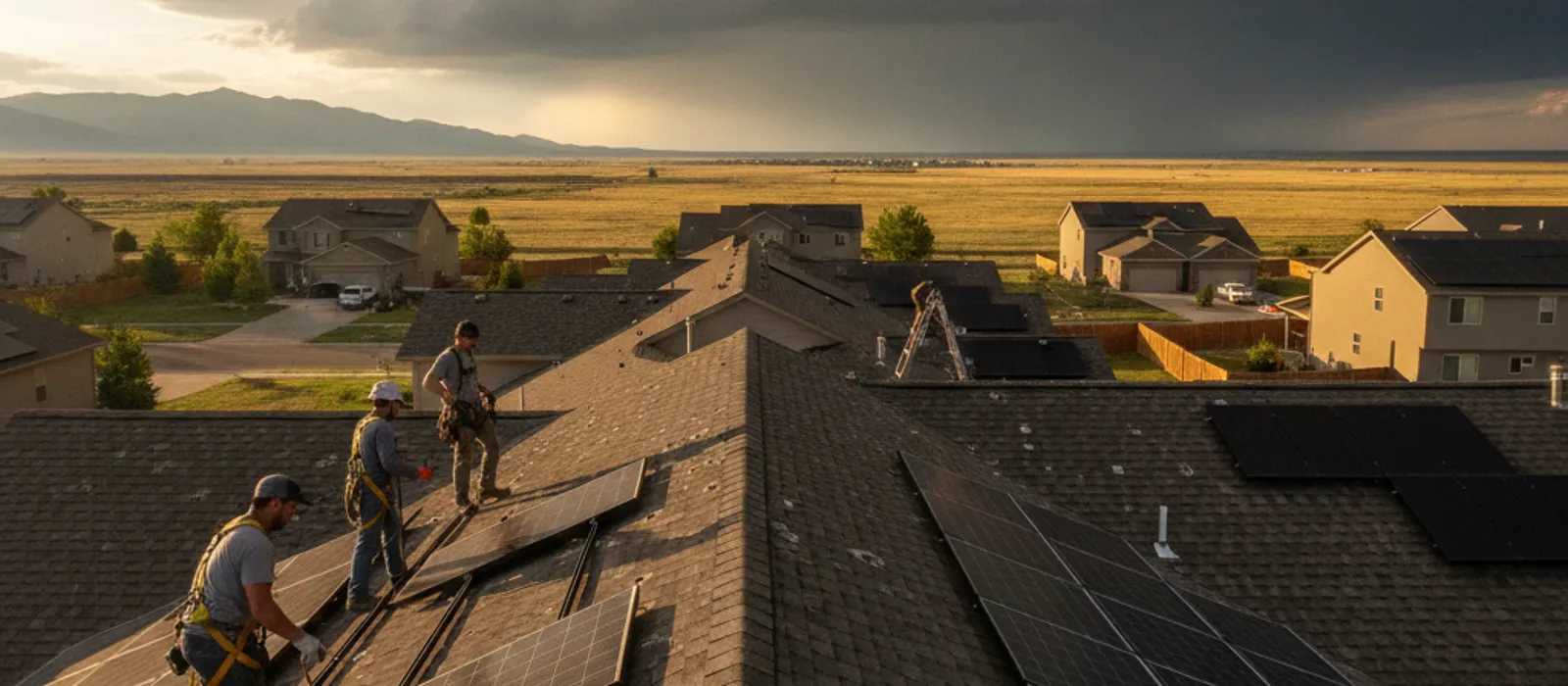
Your roofer just called. The crew shows up Thursday, and your solar panels need to be off the roof by Wednesday night. Now you’re staring at 24 panels and wondering if that’s even possible.
Here’s the honest answer to how long does solar detach and reset take: the work on your roof usually takes one day to come off and one day to go back on. But the full process, from your first phone call to your system producing power again, typically runs two to six weeks. The gap between those two numbers is where most homeowners get surprised, and it’s exactly what this article walks through.
If you’re mid-reroof in Greeley, Evans, Windsor, or anywhere in Weld or Larimer County and the clock is already ticking, call us at (970) 286-3417. We keep detach slots open for exactly this situation, and written estimates are free.
The Short Answer: One Day Off, One Day On, Weeks in Between
Let’s put real numbers on it before we get into the details.
For a typical Northern Colorado home system, meaning 15 to 30 panels on an asphalt shingle roof, here’s what the timeline looks like:
- Detach day: 4 to 8 hours. Panels come off, racking comes off, wiring is safed and labeled, everything gets stored.
- Your reroof: 1 to 3 days for most homes, though that’s your roofer’s timeline, not ours.
- Reset day: 6 to 10 hours. Racking goes back on with new flashing, panels go back up, wiring is reconnected and tested.
- Re-energizing: Same day in most cases. Sometimes a utility or inspection step adds days.
So the hands-on solar work is roughly two working days. The full start-to-finish window is longer because scheduling, roofing, weather, and paperwork all sit between those two days.
The biggest factor in your total timeline isn’t the solar crew at all. It’s coordination. When the detach, the reroof, and the reset are booked together from the start, the whole job can wrap in under two weeks. Booked separately, six weeks is common and eight isn’t rare.
How Long the Detach Itself Takes
Detach day starts early, usually 7 or 8 a.m., because afternoon wind and summer storms are real constraints on a Northern Colorado roof.
Here’s the sequence and roughly how long each step runs on a 20-panel system:
- System shutdown and lockout (30 to 45 minutes). The inverter gets powered down in the right order, the AC disconnect is opened, and the array is verified dead before anyone touches a panel. This step is why detach and reset isn’t a DIY job. Panels produce voltage any time light hits them, even disconnected from the grid, and DC arc injuries are no joke.
- Panel removal (2 to 4 hours). Each panel is unclipped, unplugged, carried down, and stacked on edge in a protected spot, usually your garage. Every connector gets capped and every string gets labeled so reset day goes fast.
- Racking and rail removal (1 to 2 hours). Rails, clamps, and mounts come off. We photograph mount locations so the reset lands on the same rafters.
- Wire management and documentation (30 to 60 minutes). Home runs are coiled and protected, penetration points are noted for the roofer, and you get photos of everything as it came apart.
That’s one real workday. A bigger system, steep pitch, or tile roof can push it toward the long end or split it across two mornings.
Detach day is also the best chance anyone will ever have to inspect your panels for hail damage, because every panel gets handled up close. If you’re reroofing because of hail, ask for that inspection in writing. Our post on the signs of hail damage on solar panels shows what we’re looking for, and finding damage while your insurance claim is still open can save you thousands.
What Happens Between Detach and Reset (and Why It Takes Weeks)
Here’s the stretch nobody budgets time for. The panels are in your garage, the roof is getting replaced, and you’re not producing power. Every day in this window costs whatever your system would’ve generated, roughly $2 to $6 a day for most homes here.
Four things fill this gap:
The reroof itself. One to three days of actual work for most homes, but roofing crews juggle weather and material deliveries just like we do. After a big hail event, Weld County roofers can be booked out four to six weeks, and your panels sit in the garage that whole time.
Weather. We don’t set panels in sustained wind above about 20 mph, and nobody roofs in rain. The National Weather Service data for our region shows the Front Range corridor sees some of the most frequent large hail in the country, mostly May through August, which is exactly when most reroofs happen. Check the seasonal outlook at weather.gov when you’re picking dates, because a stormy week can slide everything.
Roof cure and inspection. Some roofers want a day or two before anyone walks the new shingles, and some jurisdictions inspect the roof before solar goes back on.
Scheduling the reset. If you didn’t book the reset when you booked the detach, you’re going to the back of the line. This is the most avoidable delay on the whole list. Book both dates at once, every time.
Marcus in Evans learned this one the hard way last summer. He hired a roofer who “knew a solar guy” to pull his 18-panel system, paid $1,650 for the detach, and then the solar guy went quiet. His panels sat in the garage for five weeks while his system produced nothing, which cost him about $140 in lost production on top of the stress. When he called us to finish the job, the reset itself took one day. The five-week gap was pure scheduling failure, not work.
If your system’s been down for a while and you’re not sure why, our article on why a solar system stays offline after roof replacement walks through the usual causes.
How Long Does the Reset and Reinstall Take?
Reset day is usually a little longer than detach day, 6 to 10 hours for that same 20-panel system, because it includes everything detach did plus new flashing and full commissioning.
The sequence:
- Layout and mounting (2 to 3 hours). Mounts go back into the rafters, each one flashed and sealed into the new roof. Done right, every penetration gets proper flashing, not just a blob of sealant. Done rushed, this step creates the leaks you find next spring. If you ever see water stains under your array, our post on roof leaks under solar panels covers what went wrong and what to do.
- Rails and panels (2 to 4 hours). Rails get leveled and torqued, then panels go back to their original positions, which is why we labeled everything on detach day.
- Wiring and reconnection (1 to 2 hours). Strings are reconnected per the labels, connectors are inspected, and the home runs are tied back in.
- Commissioning (30 to 90 minutes). The system gets powered up in sequence, string voltages are checked against the original documentation, monitoring is verified, and you get a production reading before the crew leaves.
A reset that skips commissioning is how homeowners end up with one dead string and no idea until the utility bill jumps two months later.
Angela in Windsor had a 26-panel system reset after a June hailstorm reroof. Detach ran seven hours on a Tuesday, her roofer took two days, and we reset that Friday in about nine hours. Total system downtime: four days. Her all-in detach and reset cost was $3,100, her insurance scope covered it as part of the roof claim, and her monitoring showed full production by Friday evening. That’s what the process looks like when the detach, the roofer, and the reset are booked as one coordinated job.
Speaking of insurance, if you’re reroofing from hail damage, the detach and reset is usually a line item on the roof claim. Our guide to whether insurance covers solar detach and reset explains how that line item works and what to do if the adjuster left it off the scope.
Want a coordinated timeline for your own reroof? Request a free written estimate and we’ll give you detach and reset dates that actually line up with your roofer.
Timeline by System Size: What to Expect
Every roof is different, but system size is the best single predictor of on-roof time. Here’s what we typically see across Greeley, Johnstown, Eaton, Firestone, and Fort Lupton:
| System size | Detach time | Reset time | Typical full timeline* | Typical detach + reset cost |
|---|---|---|---|---|
| Small (8 to 14 panels) | 3 to 5 hours | 4 to 7 hours | 1 to 3 weeks | $1,200 to $2,200 |
| Average (15 to 24 panels) | 4 to 8 hours | 6 to 10 hours | 2 to 4 weeks | $2,000 to $3,500 |
| Large (25 to 40 panels) | 1 to 1.5 days | 1 to 2 days | 3 to 6 weeks | $3,000 to $5,500 |
| Complex (tile roof, steep pitch, ground handling issues) | 1 to 2 days | 1.5 to 2.5 days | 4 to 8 weeks | $4,000 to $7,000+ |
*Full timeline means first call to system re-energized, including the reroof and normal scheduling gaps.
Costs vary with roof type, access, and whether any parts need replacing, which is why quotes for the same house can differ by a thousand dollars or more. If you’re comparing bids, why solar detach and reset quotes vary breaks down what’s actually behind the spread. And if you want the deeper dive on pricing itself, our solar panel removal and reinstall cost page has current Northern Colorado numbers.
What Stretches the Timeline (and What You Can Control)
Some delays you can’t do anything about. A lot of them you can. Here’s the list, sorted honestly.
Things you can’t control:
- Weather. Wind, rain, and hail season all pause roof work. Build a buffer into your expectations from May through August.
- Utility and inspection steps. Most straightforward detach and resets in our area don’t require utility re-approval because the system isn’t changing, just moving off and back on. But if equipment gets replaced during the reset, an upgraded inverter for example, your utility may need to review it. The Department of Energy’s homeowner solar guide at energy.gov is a good plain-language reference for how utilities and permitting interact with home solar.
- Parts availability. A cracked panel or a cooked connector discovered on detach day can add a week or two if the part has to ship.
Things you can control:
- Book the detach and reset together, with your roofer’s dates in hand. This is the single biggest timeline saver. One phone call, three coordinated dates.
- Don’t let the roofing crew move the panels. It voids most solar warranties, it’s how panels crack, and it’s how you end up in a finger-pointing match between two contractors. We wrote up the full picture in can roofers remove solar panels.
- Get your insurance scope reviewed before work starts. If detach and reset isn’t on the scope, getting it added takes days. Getting it added after the work is done takes months, if it happens at all.
- Clear garage space before detach day. A crew that spends 45 minutes rearranging your garage finishes 45 minutes later.
Dave in Johnstown is the cautionary tale here. His roofer’s crew pulled his 22 panels themselves to “save him money,” stacked them flat on the driveway, and cracked three. Between $1,900 for the replacement panels, a voided workmanship warranty on the rest of the array, and a $2,400 professional reset that his insurer initially balked at because the detach wasn’t documented, his shortcut cost him over $4,300 and added a month to his timeline. A coordinated detach and reset would’ve run him about $2,800, fully on the insurance scope.
When to Stop Waiting and Make the Call
If any of these describe you, it’s time to pick up the phone rather than keep researching:
- Your roofer has given you a start date inside the next two weeks and your panels are still on the roof.
- Your panels are already off, sitting in a garage, and nobody’s given you a reset date.
- You’ve had storm damage and panels are loose, cracked, or hanging. That’s not a scheduling question, that’s a safety issue, and it’s what our emergency solar service line exists for, 24/7.
- Your system’s been reset but production looks wrong or the inverter’s throwing errors.
And a quick safety note, because it bears repeating: never disconnect, move, or reconnect solar panels yourself, and don’t let a general roofing crew do it either. Live DC voltage, roof heights, and 40-pound glass sheets are a bad combination for anyone without the right training and equipment.
The full start-to-finish answer, one more time: about two working days of actual solar work, wrapped inside a two-to-six-week process that gets a lot shorter when one company coordinates it. If you want that version, reach out for a free written estimate or call (970) 286-3417 and we’ll line your dates up with your roofer this week. You can also read more about what a solar detach and reset actually includes on our main service page.
Frequently Asked Questions
Can solar panels be detached and reset in the same week as my reroof?
Yes, and that’s the ideal setup. A typical sequence is detach Monday, reroof Tuesday through Thursday, reset Friday, which keeps your system down for less than a week. It works when the solar company and roofer coordinate dates before either crew shows up, so share your roofer’s schedule when you book.
How long will my solar system be offline in total?
If the jobs are coordinated, most homeowners are offline four to ten days. If the detach and reset are booked separately or a storm backlog hits, two to six weeks of downtime is common. At typical Northern Colorado production, each offline week costs roughly $15 to $40 in lost generation, so coordination has a real dollar value.
Does weather delay solar detach and reset work?
It can. Crews won’t set panels in sustained winds above roughly 20 mph, and rain or hail stops both roofing and solar work for the day. May through August is hail season on the Front Range, so timelines during those months should include a weather buffer of a few days.
Do I need a permit or utility approval for a detach and reset?
Usually not, because you’re reinstalling the same system in the same location, though some jurisdictions in Weld and Larimer counties want to inspect the roof or the reinstall. If any equipment changes during the reset, like a new inverter or added panels, your utility may need to review the change before you re-energize. A good detach and reset company handles that paperwork and builds it into your timeline up front.