
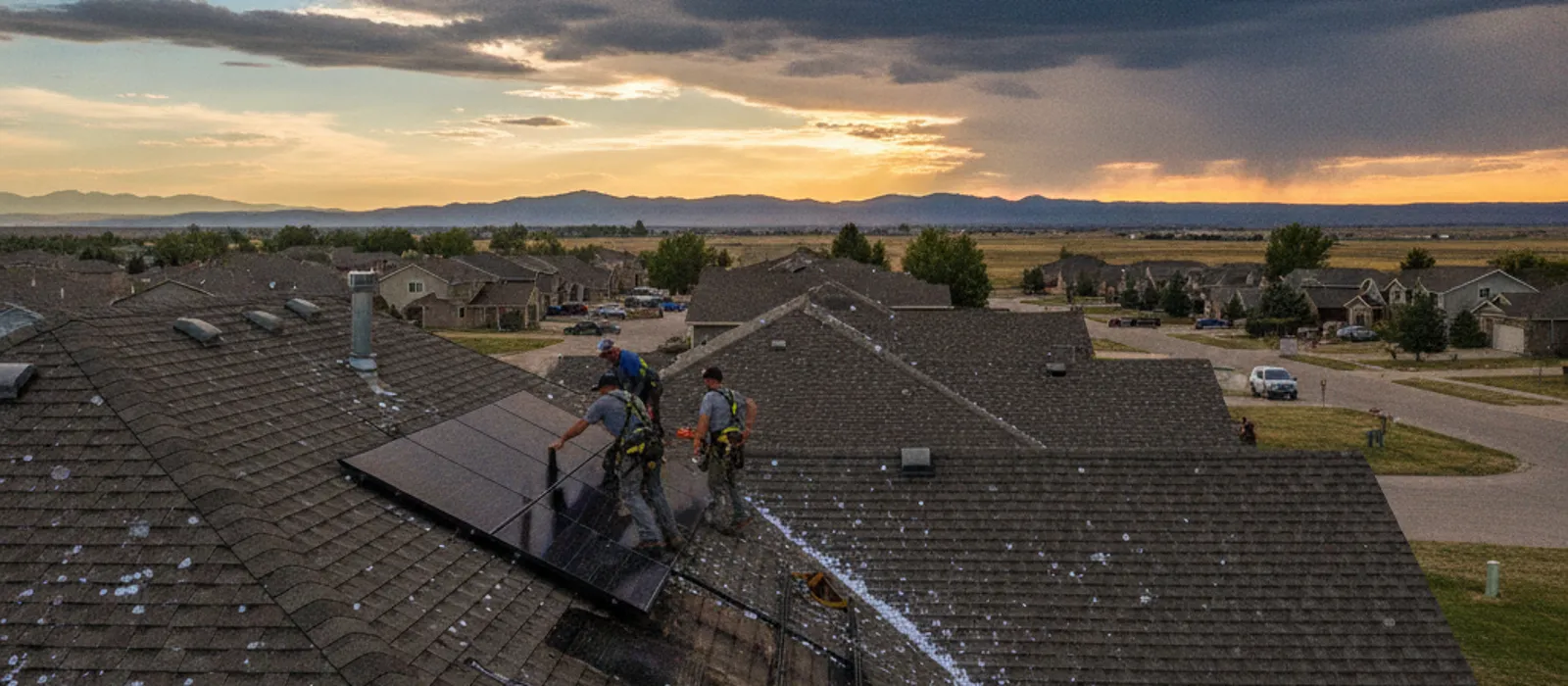
You spot a brown ring spreading across the bedroom ceiling, climb into the attic with a flashlight, and the drip trail leads straight up to the section of roof where your solar array sits. A roof leak under solar panels is one of the most frustrating problems a Northern Colorado homeowner can run into, because the thing causing the leak is hidden under the thing making your power.
You can’t see the flashing. You can’t reach the mounts. And most roofers won’t touch that section of roof until the panels come off.
Here’s the good news. These leaks are almost always fixable, the cause is usually one of a handful of known failure points, and if hail started the problem, your insurance claim probably covers more of the bill than you think. Let’s walk through what’s actually happening up there and what it takes to fix it right.
If water is actively coming in right now, don’t wait on a blog post. Call our 24/7 line at (970) 286-3417 and we’ll talk you through stopping the damage today.
Why Roof Leaks Under Solar Panels Hide for Months
A normal roof leak announces itself fast. Wind lifts a shingle, rain gets under it, and you see a stain within a storm or two.
A leak under a solar array works differently. The panels themselves shed most of the rain, so only a fraction of the water ever reaches the roof surface below them. A compromised mount or torn flashing might only take on water during wind-driven rain from a specific direction, or during a heavy spring melt when snow sits under the array for days.
That means small amounts of water can seep into your roof deck for months before enough soaks through to stain a ceiling. By the time you see the ring, the plywood around the mount may already be soft, and insulation in that bay may be wet and compressed.
This is why we tell homeowners in Greeley, Evans, and Windsor to check their attic under the array once or twice a year, especially after hail season. Ten minutes with a flashlight in October can save you a rotted deck section in April. Look for dark streaks on the underside of the roof deck, rust trails on nail tips, and any daylight around penetration points.
What Actually Causes a Roof Leak Under Solar Panels
Almost every leak we trace under an array comes back to one of six causes. Knowing which one you’re dealing with changes both the fix and the price, so it’s worth understanding all of them.
1. Lag bolts that missed the rafter. Every roof-mounted array is anchored with lag bolts that should sink into rafters or blocking. When an installer misses the rafter, the bolt is held by nothing but plywood and sealant. The sealant fails, the bolt wallows out, and water follows the bolt straight into the attic. This is the single most common cause we find on installs that leaked within the first few years.
2. Failed or missing flashing at the mounts. Good installs use metal flashing that tucks under the shingle course above each mount, so water sheds over the penetration instead of into it. Fast installs sometimes skip flashing and rely on a blob of sealant. Colorado’s freeze-thaw cycles and 100-degree roof deck summers destroy exposed sealant in five to eight years.
3. Sealant that simply aged out. Even on a well-flashed mount, sealant plays a backup role, and it has a service life. If your array is 10 or more years old and the roof underneath is original, aged sealant is a prime suspect.
4. Hail damage around the array. Hail bruises shingles, cracks flashing, and can fracture the sealant bond at every mount on the roof. The panels protect the shingles directly beneath them, which creates a strange pattern: the exposed roof gets replaced on the insurance scope, while damaged penetrations under the array get missed because nobody lifted a panel to look.
5. Cracked or shifted conduit penetrations. Your array’s wiring enters the roof or wall somewhere. Those penetration points have their own flashing and sealant, and they fail the same ways mounts do.
6. A roof that was already at end of life when the panels went on. Panels last 25 to 30 years. If they were installed on a roof that had 8 years left, the shingles under and around the array will fail on schedule regardless of how good the solar work was. The U.S. Department of Energy’s homeowner solar guidance specifically recommends dealing with roof condition before panels go up for exactly this reason.
Mark, a homeowner in Evans, called us after finding water stains in his attic two years after his install. We lifted four panels and found three lag bolts that had missed the rafter entirely. The fix ran him $2,850 for a partial detach, deck patch, new properly flashed mounts, and reset. Not cheap, but a fraction of what the rot would have cost him in year five.
Is It the Roof or the Solar Mounts? How to Tell
Before anyone quotes you a fix, you need a real diagnosis. Here’s how we narrow it down, and how far you can safely get on your own.
Start in the attic, not on the roof. On a dry day, find the stained area and trace upward. Water travels along rafters and decking before it drips, so the entry point is usually uphill from the stain. If the trail dead-ends at a bolt tip poking through the deck, you’ve likely got a mount problem. If it traces to a valley, vent, or open shingle field, the roof itself is the more likely culprit.
Pay attention to when it leaks. A leak that only shows up during wind-driven rain from the west, or days after a snow load melts off, points to a marginal penetration that only takes on water under specific conditions. A leak with every rain points to a more open failure.
Check the roof’s age and the array’s age. A 22-year-old roof with 6-year-old panels probably has a shingle problem. A 5-year-old roof with 5-year-old panels probably has an install problem.
Know where DIY stops. Attic inspection with a flashlight is fair game. Walking a roof around energized solar equipment is not. The panels and their wiring carry live DC voltage whenever the sun is up, mounts and rails are trip hazards, and lifting a panel wrong can crack it or void its warranty. Once the diagnosis requires lifting panels or opening up mounts, that’s the moment to call a pro. Our crews do this every week, and a diagnostic visit is a lot cheaper than a fall or a fried string of panels.
Want a second set of eyes on it? Request a free written estimate and we’ll tell you honestly whether this is a solar-mount fix, a roofing fix, or both.
Fixing a Leak Under Solar Panels: Your Real Options
Once you know the cause, the fix falls into one of four buckets.
Option 1: Sealant-only patch. Someone climbs up, finds the suspect mount, and reseals it without lifting panels. It’s the cheapest option and the one most likely to fail, because you can’t properly flash a mount you can’t fully access, and you usually can’t even confirm you found the right mount. We consider this a stopgap to buy time before a real repair, not a fix.
Option 2: Partial detach and repair. We remove only the panels over the problem area, pull the failed mounts, repair the decking if needed, install new flashed mounts, and reset the panels. This is the right call when the roof itself has plenty of life left and the failure is localized. Most jobs like this take one day.
Option 3: Full detach and reset with roof work. If the roof is at end of life or a hail claim is paying for a replacement, the whole array comes off, the roofer does their work on a clean deck, and we reinstall on new, properly flashed mounts. If you’re not familiar with how that process works, our plain-English explainer on what a solar detach and reset actually involves walks through it step by step. This is the gold standard fix because every penetration on the roof gets renewed at once.
Option 4: Permanent removal. Rare, but if the system is old, underproducing, or the numbers no longer work, some homeowners have us remove the array for good and cap the roof cleanly.
One warning from the field. Luis in Johnstown tried Option 1 himself with a $40 tube of roofing sealant over what he thought was the bad mount. He sealed the wrong penetration, the leak kept running for another four months, and by the time we opened it up, the deck repair had grown from a patch to a 4-by-8 sheet. His final bill was $1,900 instead of the roughly $600 a targeted early repair would have cost.
What These Repairs Cost in Northern Colorado
Every roof is different, but here’s the realistic range we see across Greeley, Windsor, Johnstown, Eaton, Firestone, and Fort Lupton. These figures assume a typical residential array of 15 to 25 panels on an asphalt shingle roof.
| Fix | Typical Cost Range | When It Makes Sense |
|---|---|---|
| Sealant-only patch | $150 to $500 | Stopgap only, buying time before real repair |
| Partial detach and mount repair | $800 to $3,500 | Localized failure, roof has 10+ years left |
| Full detach and reset (labor only) | $2,500 to $6,000 | Reroof needed, hail claim, or multiple failed mounts |
| Detach and reset plus new roof | $12,000 to $25,000+ | End-of-life roof or storm total, often insurance-paid |
| Interior repairs (drywall, insulation, paint) | $500 to $3,000 | Added to any option where water got inside |
Two things move these numbers more than anything else. First, how long the leak ran before someone fixed it, because wet decking and interior damage stack costs fast. Second, who’s paying. When hail caused the damage, the detach and reset labor is normally a line item on the insurance scope, and we’ve covered how insurance handles solar detach and reset in detail if you’re heading into a claim.
For a full breakdown of what drives the labor side, see our solar panel removal and reinstall cost guide.
When Hail Is the Real Cause of the Leak
In Weld and Larimer counties, a lot of “mystery” leaks under arrays trace back to a hail storm months earlier. The National Weather Service tracks severe hail across our region every year, and their hail safety and reporting page is a good reference for what qualifies as severe. Stones big enough to total a roof are also big enough to crack flashing and break sealant bonds at solar penetrations.
Here’s the trap. The adjuster scopes the roof, approves a replacement for the exposed shingle field, and nobody lifts a panel. The reroof happens around the array or with a rushed detach, the damaged penetrations under the panels never get addressed, and the homeowner inherits a slow leak under a brand-new roof.
Dana in Windsor lived exactly this. Her 2024 hail claim paid $14,500 for a reroof, but the original scope had no solar line item at all. We documented the mount damage under her array, her contractor submitted a supplement, and the carrier added $3,200 for a proper detach and reset. Her penetrations were renewed along with the shingles, and the ceiling stain that prompted her first call never came back.
If your roof took hail in the last couple of seasons, check the panels too, not just the shingles. Our guide to spotting hail damage on solar panels covers what’s visible from the ground, and our solar hail damage service page explains how we document mount and panel damage in a format adjusters actually accept.
The window matters here. Most Colorado policies give you a limited time to file or supplement after the storm date, so a leak you notice in March from a storm last July is worth acting on now, not next fall.
The Bottom Line for Your Roof and Your Array
A roof leak under solar panels is a solvable problem, and catching it early is the whole game. Check the attic under your array a couple of times a year, treat any stain near the array as a mount issue until proven otherwise, and don’t let anyone smear sealant on it and call it fixed.
When the repair needs panels lifted, use a crew that handles solar detach and reset every day. Our detach and reset service in Greeley covers everything from a four-panel partial lift to full-array removals for reroofs, with the system tested and producing before we leave.
Get it looked at before the next storm hits. Call (970) 286-3417 or request your free written estimate, and we’ll give you a straight answer on what’s leaking, what it’ll cost, and whether insurance should be picking up part of the tab.
Frequently Asked Questions
Do solar panels cause roof leaks?
Panels themselves don’t cause leaks, but the mounting hardware penetrates your roof, and any penetration is a potential leak point if it’s installed badly or ages out. A properly flashed install on a healthy roof can go decades without a drip. Most leaks we trace come from missed rafters, skipped flashing, or sealant that simply reached the end of its life.
Can a roofer fix a leak under my panels without removing them?
Not properly. Flashing a mount requires lifting the surrounding shingles and usually the panels above it, and reputable roofers won’t warranty work they can’t fully access. Sealant applied around the edges of an installed mount is a temporary patch at best. A partial detach of just the affected panels is usually the honest fix.
Will my homeowners insurance cover a leak under my solar array?
It depends on the cause. Sudden storm damage, including hail that compromised your mounts or flashing, is typically covered, and the detach and reset labor can be added to the claim scope. Slow leaks from installer error or plain old wear are usually not covered, though a newer install may still be under the installer’s workmanship warranty.
How long does a repair like this take?
A partial detach with mount repair is usually a one-day job, including resetting the panels and confirming the system is back online. A full detach and reset around a reroof typically adds one day on each side of the roofing work. Interior drywall and paint repairs, if the leak ran a while, are scheduled separately and add a few days.