
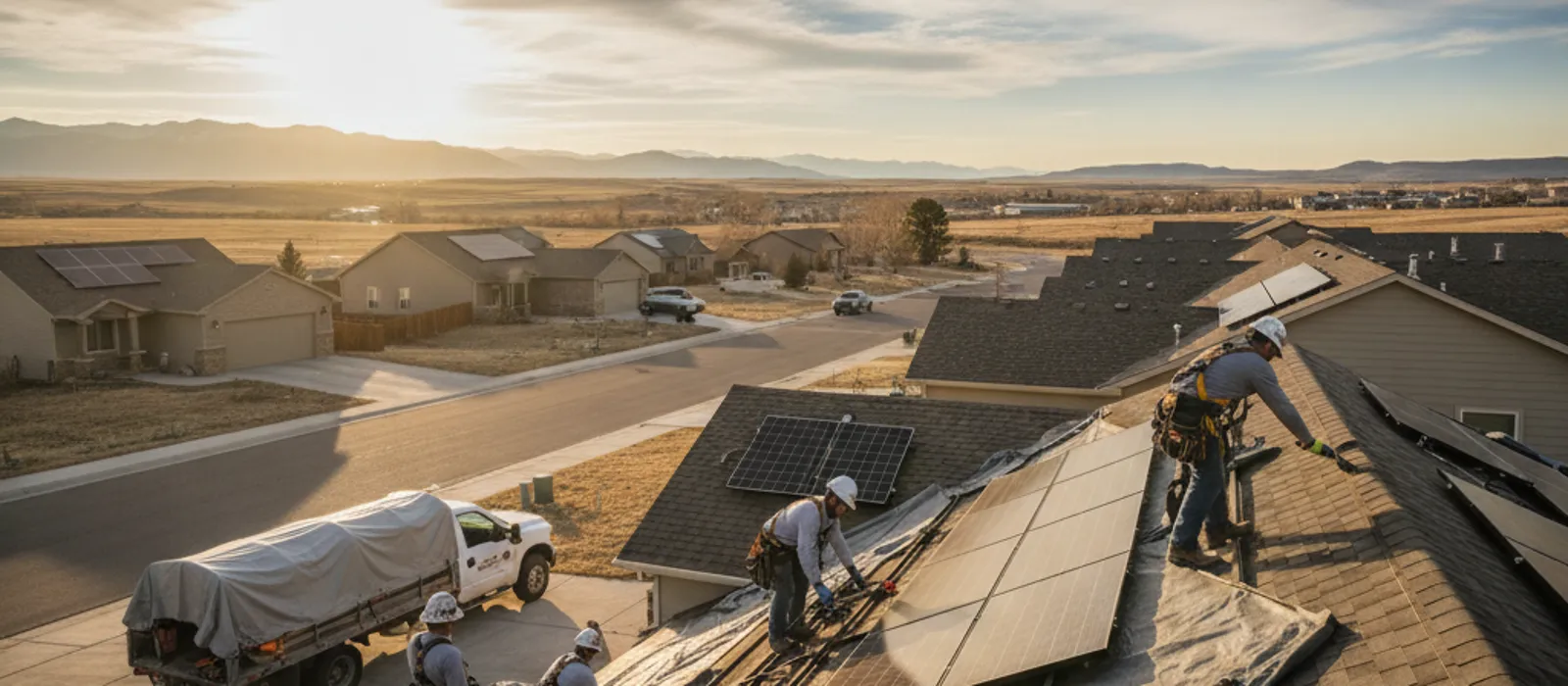
Your roofer just walked your hail-hammered roof, handed you a bid, and then pointed at your solar array and said “those have to come off first, and that’s not us.” Now you’re stuck mid-claim wondering who actually does that part.
So can roofers remove solar panels? In most cases, no, and the reasons aren’t just company policy. In Colorado, disconnecting and reconnecting a grid-tied solar system is electrical work, and roofing crews generally aren’t licensed, insured, or trained to touch it. The few who say yes are usually subcontracting it out anyway, or worse, sending shingle guys up to unbolt live equipment.
Here’s what’s really going on, what it should cost, and how to line up the solar work so your reroof doesn’t stall for two weeks with panels stacked in your garage.
Why Your Roofer Keeps Saying “That’s Not Us”
Roofers in Weld and Larimer counties see solar arrays on a big share of the roofs they bid now. Most of them still won’t touch the panels, and it comes down to four things.
Licensing. A grid-tied solar system is wired into your main electrical panel. Shutting it down, disconnecting it, and re-energizing it later is electrical work under Colorado law, and that work runs through licensed electricians registered with the state. You can look up how Colorado regulates this through the Colorado Division of Professions and Occupations electrical board. A roofing license doesn’t cover any of it.
Insurance. Roofers carry general liability for roofing. If a crew member drops a panel, cross-wires a string, or backfeeds something they shouldn’t, their policy likely won’t respond because they were performing work outside their trade. That leaves you holding the bag.
Warranties. Panel and inverter manufacturers can deny warranty claims if unqualified people handled the equipment. Your installer’s workmanship warranty often has the same language. One roofing crew’s afternoon of “helping” can quietly void protection on a $25,000 system.
Liability they can see coming. Experienced roofers have watched this movie. They know a cracked cell or a torqued connector doesn’t always show up until months later, and they don’t want that phone call.
So when your roofer says “get your solar guy,” they’re not dodging work. They’re telling you the truth about where their lane ends. That’s exactly the gap a dedicated detach and reset service in Greeley exists to fill. If you’re at that stage now, call us at (970) 286-3417 and we’ll get you a free written estimate that slots into your roofer’s schedule.
Can Roofers Remove Solar Panels Legally in Colorado?
Legally, a roofing company can’t perform the electrical side of solar removal unless they have licensed electricians on staff, and almost none do. That’s the short answer. The longer answer is where homeowners get burned, because “removal” is really three jobs bundled together.
First is the electrical disconnect. Someone has to shut down the inverter, open the AC and DC disconnects, verify the system is de-energized, and safely cap or protect the wiring that stays behind. Grid-tied systems feed power back toward the utility, so this isn’t like unplugging a lamp. The Department of Energy has a good plain-language overview of how grid-connected home solar systems work if you want the background.
Second is the physical removal. Panels come off the rails, rails come off the mounts, and everything gets labeled and stored so it goes back exactly where it was. Modern panels are tougher than they look but they don’t tolerate being carried flat, stacked wrong, or leaned against a fence for two weeks.
Third is the reinstall and recommissioning. After your new roof is on, the mounts go back with proper flashing, the array gets rebuilt, and the system gets re-energized and tested. Skip the testing step and you may not find out for months that one string never came back online. We wrote about that exact problem in why solar systems end up offline after roof replacement.
A roofing crew can sometimes legally do part of job two. They can’t do jobs one and three. And splitting one continuous process across two companies that don’t talk to each other is how panels get damaged and warranties get contested.
Take Mike in Evans. His roofer said they’d “handle everything” after last summer’s hail. The roofer subbed the panel work to a general labor crew, who stacked seventeen panels face-down on his driveway. Three came back with cracked glass and two more had micro-crack damage that showed up in production numbers later. The labor crew’s insurance denied the claim, the roofer pointed at the sub, and Mike ate about $3,800 replacing panels his insurer had already paid to protect.
What Actually Happens When a Roofing Crew Removes Solar Panels
When homeowners tell us a roofer offered to include panel removal “free” or for a few hundred dollars, we ask them to find out exactly who’s doing the work. The answers usually fall into three buckets.
Bucket one: they sub it to a real solar contractor. This is the good outcome. But you’re still paying full price for the solar work, it’s just buried in the roofing bid where you can’t see it or compare it. You also don’t get to vet the solar crew, and if your insurance scope pays a line item for detach and reset, you want that money going to the actual work.
Bucket two: they send their own guys up. No electrical license, no solar-specific insurance, no torque specs, no string map. Panels get leaned against the garage, connectors get left open to the weather, and nobody photographs the racking layout before teardown. Reinstall day becomes a guessing game.
Bucket three: they tell you to figure it out. Honestly, this is fine. It’s the roofer being straight with you. The problem is timing, because if you wait until the roofing crew is scheduled to start looking for solar help, you can lose one to three weeks while your claim clock keeps running.
Dan in Windsor hit bucket three. His roofer gave him ten days’ notice, and his original solar installer had gone out of business, which is common along the Front Range. His insurance scope initially had nothing for solar. We documented the system, gave him a written detach and reset quote, and his adjuster approved a supplement for $2,650 to cover it. The panels came off on a Tuesday, the roof went on Wednesday and Thursday, and the array was back up and producing by Friday afternoon. Total added delay to his reroof: zero days.
If your adjuster’s scope doesn’t mention the solar work yet, read does insurance cover solar detach and reset before you sign anything, then reach out through our contact form and we’ll put real numbers in front of your adjuster.
What a Proper Detach and Reset Looks Like
A legitimate detach and reset crew treats your system like it has to come back at 100 percent, because it does. Here’s the sequence you should expect. We break the full process down in what is solar detach and reset, but the short version looks like this.
Before anything comes loose, the crew documents baseline production, photographs the array and racking layout, and maps every string. Then the system gets shut down in the correct order, verified dead, and disconnected by someone qualified to do it.
Panels come off one at a time, get inspected, labeled, and stored on edge in a protected spot, usually your garage. Rails and mounts come off next, and old mount holes get noted so the roofer can seal them properly.
Then the roofers do their thing. A good solar crew coordinates directly with the roofing foreman on flashing and mount placement so the new roof’s warranty and the array’s attachment points don’t fight each other.
After the roof passes inspection, the array goes back on: mounts flashed into the new shingles, rails leveled, panels torqued to spec, wiring re-run and secured. The last step matters most, which is recommissioning. The crew re-energizes the system, confirms every string is producing, checks the monitoring platform, and hands you before-and-after production numbers.
That last step is the difference between a company that resets solar systems and a crew that reinstalls hardware. Roughly a third of the service calls we run are for systems another crew put back up that never got tested.
Roofer “Included” Removal vs. a Dedicated Solar Crew: Cost and Risk
Here’s how the two paths actually compare for a typical 20-panel residential system in Northern Colorado.
| Factor | Roofer “handles it” | Dedicated detach and reset crew |
|---|---|---|
| Typical cost (20 panels) | $0 to $1,500 quoted, real cost hidden in bid | $2,000 to $4,000, itemized in writing |
| Electrical disconnect/reconnect | Often skipped or improvised | Performed and verified by qualified techs |
| Panel handling | Stacked, leaned, unlabeled | Inspected, labeled, stored on edge |
| Insurance billing | Buried, hard to supplement | Line-itemed for your adjuster |
| Manufacturer warranty | At risk | Protected with documentation |
| Recommissioning and testing | Rarely done | Standard, with production report |
| Who answers when output drops later | Roofer and sub point at each other | One company, one number |
The honest math: paying a real solar crew usually costs $1,000 to $2,500 more than a roofer’s “included” price on paper. But hail claims routinely cover the detach and reset as its own line item, so the difference often isn’t coming out of your pocket at all. And one cracked panel or a dead string can erase the savings several times over. Our cost guide for panel removal and reinstall breaks down current pricing by system size.
Teresa in Johnstown learned this the expensive way. Her roofer’s crew removed and reinstalled her 24-panel array for $1,200. Six weeks later her electric bill jumped because half the array wasn’t producing, and the roofer wouldn’t come back for “electrical stuff.” She paid us $1,900 to troubleshoot, rewire two strings the crew had mismatched, and replace connectors that had been left unmated in a rainstorm. Her total came to $3,100 for work her insurer would have covered once at the proper price.
How to Line Up the Solar Work With Your Reroof
You don’t need to become a project manager. You need to make three phone calls in the right order.
Call the solar crew before the roofer schedules the tear-off. Detach usually happens one to two days before roofing starts. Give a good local crew a week’s notice and this is easy. Give them 48 hours in peak hail season and it gets tight for everyone.
Get the detach and reset quoted in writing, separately. Your adjuster needs a real number from a real solar company to approve the line item. A vague allowance inside a roofing bid gets questioned. A written scope with panel count, system size, and labor rarely does.
Make sure the two crews talk. One five-minute call between our lead and your roofing foreman about mount flashing prevents most of the leaks people blame on solar. If you’ve already got water coming in around your array, that’s a different conversation and a faster one, so start with roof leaks under solar panels.
A few honest safety notes. Don’t try to disconnect or move panels yourself. Even with the inverter off, DC wiring from the panels can stay live in daylight, and a 40-pound panel on a steep, hail-slicked roof is a fall risk before you factor in the electricity. And if a storm has left panels loose, dangling, or shattered, stay off the roof entirely and treat it as an emergency callout.
Reroofing this month? Call (970) 286-3417, day or night for storm damage, or request a free written estimate. We’ll coordinate directly with your roofer so your panels come off on time, go back on right, and get tested before we leave the driveway.
Frequently Asked Questions
Can my roofing company legally remove my solar panels in Colorado?
Generally no. The disconnect and reconnect portions are electrical work regulated by the state, and roofing companies almost never have licensed electricians on staff. Some roofers subcontract the work to real solar crews, which is legal, but you should know who’s actually on your roof and confirm they’re insured for solar work specifically.
How much does it cost to have solar panels removed and reinstalled for a new roof?
Most Northern Colorado homeowners pay $2,000 to $4,000 for a full detach and reset on a typical residential system, depending on panel count, roof pitch, and racking type. Larger systems and steep or multi-level roofs run higher. If your reroof is part of a hail claim, insurance usually covers this as its own line item.
Will removing my panels void the solar warranty?
It can if unqualified people do the work. Panel and inverter manufacturers can deny claims tied to improper handling, and many installer workmanship warranties have similar language. Using a qualified solar crew that documents the removal and reinstall protects your position if you ever need to file a warranty claim.
How long do the panels stay off during a roof replacement?
Usually two to four days total. Panels come off one or two days before tear-off, the roof goes on, and the array is reinstalled and recommissioned right after the roof passes inspection. Weather and inspection scheduling can stretch that, but a coordinated crew keeps your production loss to a few days at most.