
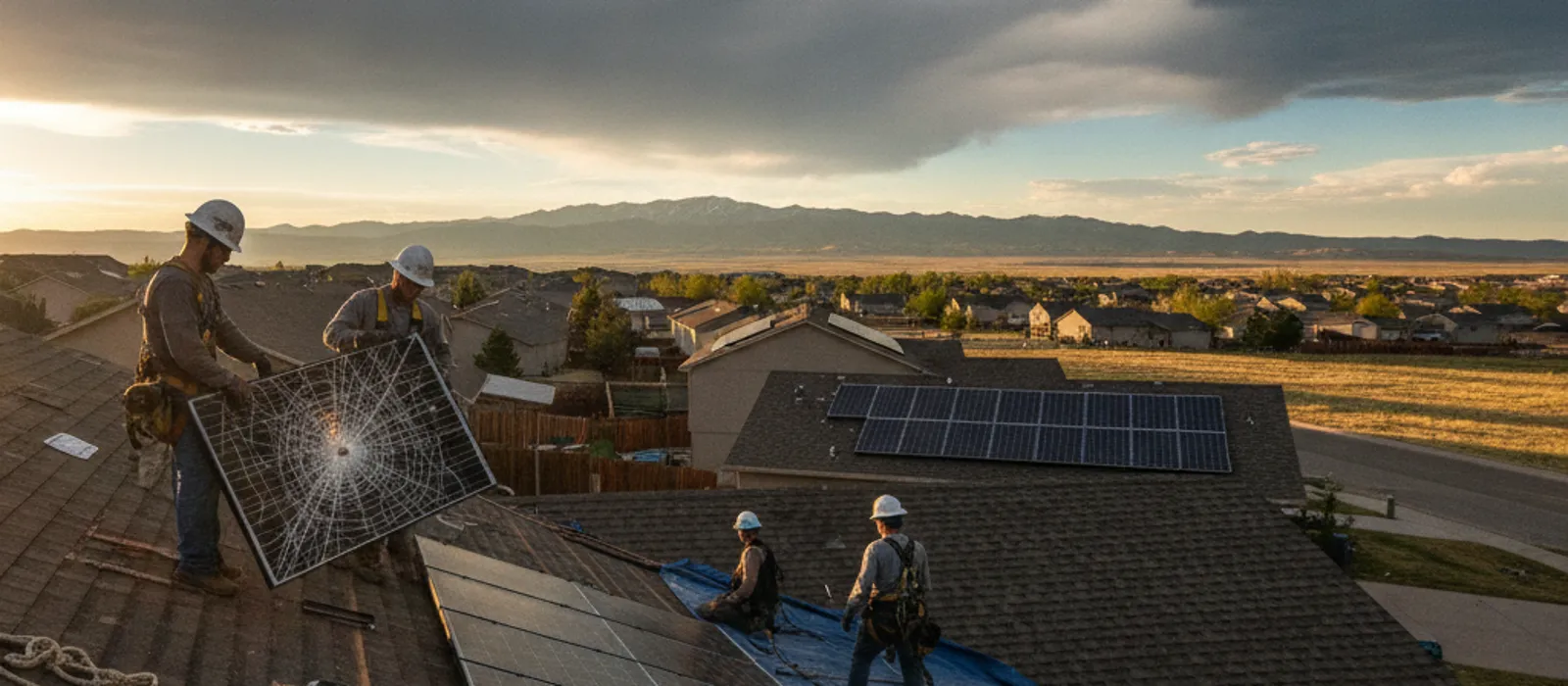
That June hailstorm cratered your shingles, dented your gutters, and left your solar panels looking absolutely perfect. Don’t trust it.
Solar panel micro cracks from hail are the most common damage we find in Weld and Larimer counties, and they’re invisible from your driveway. They’re often invisible from three feet away. The glass survives the impact, but the silicon cells underneath fracture like a windshield hit by a pebble, and those fractures quietly eat your production for the next ten years.
If your roof took hail hard enough to need replacement, your panels took the same hits. Here’s how micro cracks work, why they matter for your insurance claim, and how to catch them before your adjuster closes the file.
Why Micro Cracks Are the Sneakiest Hail Damage in Northern Colorado
Hail damage on a roof is obvious. Bruised shingles, exposed mat, granules in the downspouts. Your roofer circles it with chalk and the adjuster approves the scope.
Solar panels play by different rules. The tempered glass on a modern panel is rated to survive 1 inch hail at around 50 mph in lab tests. Northern Colorado routinely throws golf ball and larger hail at us, sometimes wind-driven at highway speeds. The National Weather Service tracks hail up to softball size along the Front Range, and you can read their hail safety basics at weather.gov.
So here’s the trap. The glass often holds. Homeowners look up, see no shattered panels, and tell the adjuster the solar is fine. Meanwhile the crystalline silicon cells under that glass, each one thinner than a credit card, have hairline fractures running through them.
Those fractures don’t show up in photos from the ground. Most don’t show up in photos from the roof either. And once your claim closes without them documented, getting a supplement approved gets a lot harder.
Marcus in Evans learned this the hard way. After the storm that totaled his roof, his installer did a quick visual check and said the array looked clean. Eight months later his monitoring app showed production down 21 percent compared to the prior summer. Electroluminescence testing found cell fractures in 11 of his 24 panels. His insurer eventually paid $14,600 to replace them, but only after a reopened claim, two inspections, and four months of back and forth that a proper inspection during the reroof would have skipped entirely.
If you’re mid-reroof right now and nobody has actually tested your panels, get in touch with us before the adjuster finalizes the scope. A free written estimate and a documented inspection now beats a supplement fight next spring. You can also call us at (970) 286-3417, including the 24/7 line if you’ve got active storm damage.
How Hail Causes Micro Cracks in Solar Panels
A solar panel is a sandwich. Tempered glass on top, a plastic encapsulant layer, then the silicon cells, then a backsheet. The glass is built to flex and spread impact energy. That flex is exactly the problem.
When a hailstone hits, the glass dimples inward for a fraction of a second. The silicon cell underneath doesn’t flex. It’s brittle, like a ceramic tile. So it cracks in a starburst or branching pattern radiating from the impact point, while the glass springs back to looking factory fresh.
A few things make it worse here in Greeley and the surrounding towns:
- Repeat storms. A panel that survived one hailstorm with minor fractures gets hit again the next season. Cracks grow and connect.
- Wind-driven hail. Angled impacts concentrate force on panel edges and corners, where cells crack more easily.
- Temperature swings. Our 40 degree day-to-night swings expand and contract the cells daily. Existing micro cracks widen a little every cycle.
- Rough handling during reroofs. Panels pulled by a roofing crew without solar training pick up new fractures from flexing, stacking, and drops. That’s one reason we wrote about whether roofers should remove solar panels at all.
The result is a panel that passes a glance test and fails a performance test.
What Micro Cracks Actually Do to Your Production
A micro crack by itself doesn’t kill a panel. It isolates slivers of the cell so current can’t flow through them. One small crack might cost you a fraction of a percent. The problem is they never stay small, and they never come alone after hail.
Researchers at the National Renewable Energy Laboratory in Golden have studied how cracked cells degrade faster than healthy ones, especially under thermal cycling like ours. You can dig into their photovoltaic reliability work at nrel.gov. The short version: cracked cells lose more power every year than intact ones, and the losses accelerate.
Here’s the typical progression we see on Front Range roofs:
- Year one: Production dips 3 to 10 percent. Most homeowners miss it or blame weather.
- Years two to three: Cracks widen. Dead zones grow. Snail trails, those brown squiggly lines, start showing at crack sites as moisture creeps in.
- Years three to five: Isolated cell sections create hot spots, where blocked current turns into heat. Hot spots can brown the backsheet and in rare cases become a fire risk. We covered that in our post on solar panel hot spots.
- Beyond: Bypass diodes fail, whole panel strings underperform, and inverters start throwing errors.
Dana in Windsor saw exactly this arc. Her roofer told her the panels were fine after a 2024 storm. When we detached her array for a reroof this spring, 9 of her 18 panels showed snail trails you could see once the panels were on the ground in good light. Her production logs backed it up: down 17 percent. We documented everything, her adjuster reopened the hail claim, and the supplement came back at $11,200 for panel replacement, on top of the detach and reset she was already getting.
How to Check for Micro Cracks From Hail Without Guessing
You can’t see micro cracks from the ground, and you shouldn’t be climbing on a hail-damaged roof to look for something that’s invisible anyway. Stay off the roof. Here’s what actually finds them, from free to definitive:
1. Pull your production data. This is the one thing every homeowner can do safely from the couch. Open your monitoring app and compare the 30 days after the storm to the same window last year, adjusting for obviously cloudy stretches. A drop of 5 percent or more with no other explanation is a red flag. Our guide to the signs of hail damage on solar panels walks through what else to look for.
2. Check your inverter for new faults. Ground fault, isolation, or string underperformance errors that started after the storm often trace back to cracked cells or damaged wiring.
3. Thermal imaging. An infrared camera, often drone-mounted, spots the hot spots that cracked cells create under load. It’s fast and doesn’t require touching the array.
4. Electroluminescence (EL) testing. This is the definitive test. The panel gets energized in the dark and photographed with a special camera, and cracks show up like bones on an X-ray. It’s the evidence adjusters have the hardest time arguing with.
Here’s roughly what detection and repair run in our area:
| Item | Typical cost in Northern Colorado | What it tells you or fixes |
|---|---|---|
| Production data review | Free (DIY) | Whether output dropped after the storm |
| Drone thermal scan | $150 to $400 per array | Hot spots from cracked or failing cells |
| EL testing | $50 to $125 per panel | Definitive map of every micro crack |
| Replace one damaged panel | $400 to $900 installed | Restores that panel’s full output |
| Replace a hail-damaged array (insurance scope) | $10,000 to $30,000+ | Full production restored, usually claim-covered |
If those replacement numbers made you wince, remember that a documented hail claim usually covers them. That’s the whole point of catching micro cracks while the claim is still open.
Micro Cracks and Your Hail Insurance Claim
Colorado insurers see more hail claims than almost anywhere in the country, and adjusters here know roofs cold. Solar is where scopes get thin. A ground-level photo of intact glass often becomes “no solar damage observed” in the report, and the claim closes with your cracked panels still on the roof.
You can push back, but timing matters:
- Get the panels inspected before the scope is finalized. Adjusters approve line items far more readily during the original claim than in a reopened one.
- Insist on evidence, not eyeballs. Production data, thermal images, or EL photos turn “the homeowner thinks the panels are damaged” into documentation.
- Use the reroof as your inspection window. If your roof is being replaced, the panels are coming off anyway. On the ground, in good light, with a trained tech handling them, is the best inspection you’ll ever get.
- Know the deadline. Most Colorado policies give you 365 days from the date of loss to file or amend hail claims, and some are shorter. Don’t sit on a hunch.
We break down the coverage side in detail in does insurance cover solar detach and reset, and if your array does need panels swapped, our post on hail-damaged solar panel replacement cost covers real numbers.
Tom in Johnstown is the good version of this story. His roofer flagged us in early, before the adjuster’s second visit. We EL-tested the array during the detach, found fractures in 6 of 20 panels, and handed the adjuster the images with the panel serial numbers matched to the report. The supplement for $5,400 in panel replacements was approved in nine days, and his reroof never stalled waiting on it.
If you’re at this stage, request a free written estimate and tell us where your claim stands. We work with adjusters every week and we’ll tell you straight whether your panels are worth testing.
What a Proper Detach and Reset Catches That a Reroof Alone Misses
A solar detach and reset is when your panels come off for the roof replacement and go back on after. Done right, it’s also a full physical for your solar system, and it’s the single best time to find micro cracks from hail.
During a detach and reset, every panel gets handled individually. That means:
- Ground-level inspection of every panel, front and back, in daylight
- Optional EL or thermal testing while panels are off the roof
- Checking every clamp, rail, and flashing point for hail and wind damage
- Inspecting wiring, connectors, and grounding that’s been baking under the array
- Documented condition reports with serial numbers, which is exactly what supplements are built on
Compare that to a roofing crew stacking panels in the yard, and the difference isn’t subtle. Panels flexed off the rails, leaned against a fence face-down, or restacked without corner protection pick up brand new micro cracks that no storm caused, and nobody’s insurance covers careless handling.
This is why we tell homeowners not to treat the solar as a line item on the roofing bid. It’s a licensed electrical system that’s about to be dismantled and rebuilt. If you want the full picture of the process, our page on hail damage solar service in Greeley covers how inspection, claims, and the reset fit together.
One more thing worth saying plainly: don’t test panels yourself. A solar array produces lethal DC voltage any time light hits it, even when the inverter is off. Disconnecting connectors, lifting panels, or probing wiring is professional work. Your job is the monitoring app and the phone. Ours is the roof.
The Bottom Line for Greeley Homeowners
If hail hit your roof hard enough to trigger a replacement, assume your panels took damage until real testing says otherwise. Micro cracks are invisible, they get worse every season, and the window to claim them closes fast once your file does.
Check your production numbers today. If they’re down, or if your reroof is scheduled and nobody has talked about testing the panels, call us at (970) 286-3417. Free written estimates, licensed and insured, and a 24/7 emergency line when the next storm rolls through Weld County.
Frequently Asked Questions
Can solar panel micro cracks from hail be repaired?
No, not in any practical sense. Once the silicon cell is fractured, there’s no way to rejoin it, and the crack will keep growing with every temperature cycle. The fix is replacing the affected panels, which is why documenting the damage for your hail claim matters so much. Panels with minor cracks still produce power, just less of it, so replacement timing is partly an economics question.
How do I know if my panels have micro cracks if I can’t see them?
Start with your monitoring data and compare production before and after the storm, using the same weeks from the prior year. A sustained drop of 5 percent or more is worth investigating. From there, a drone thermal scan or electroluminescence testing gives you a definitive answer, and both are commonly done during a detach and reset when panels are already off the roof.
Will my insurance cover panels with micro cracks?
Usually yes, if the cracks are documented as hail damage while your claim is open. The challenge is evidence, because adjusters won’t pay on a hunch. EL images or thermal scans tied to panel serial numbers, plus production data showing the drop, get supplements approved. Waiting until after the claim closes makes approval much harder, so test before the scope is final.
Do micro cracks mean my whole system is ruined?
Almost never. Hail damage is usually uneven, so some panels fracture badly while their neighbors test clean. A typical outcome is replacing a third to half the array while the rest goes back up in the reset. That’s another reason panel-by-panel testing beats a blanket judgment in either direction, because you shouldn’t pay to replace good panels or keep bad ones.