
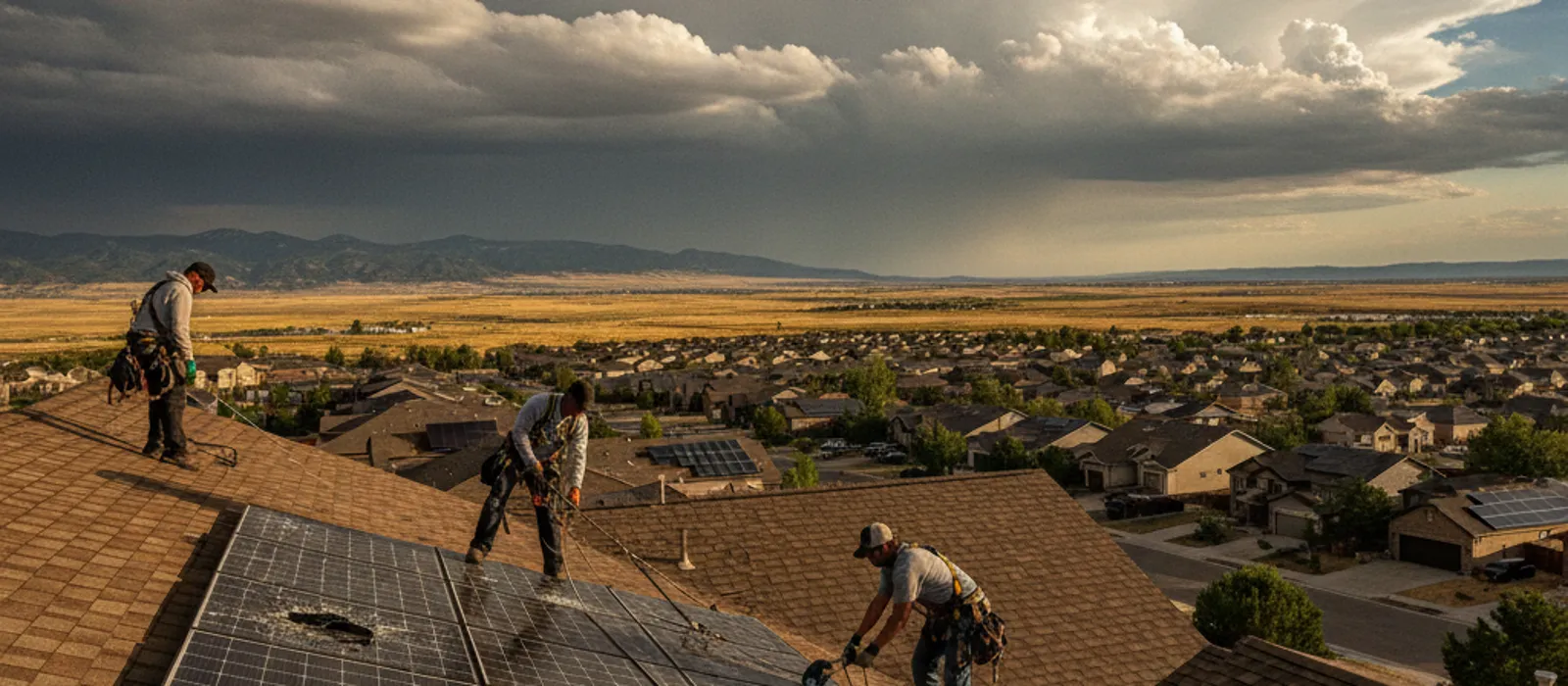
One hailstorm over Weld County can turn a solar array that was paying for itself into a five-figure question mark sitting on your roof. If you just walked outside to find dented gutters, a shredded garden, and a few panels that look like a windshield after a rock fight, you’re probably asking the same thing every homeowner asks us: what’s this going to cost me?
Here’s the honest answer on hail damaged solar panel replacement cost in Northern Colorado. Most homeowners pay somewhere between $400 and $750 per panel installed, and full-system replacements on a typical home run $12,000 to $25,000 before insurance. But the sticker price is only half the story. What you actually pay out of pocket depends on your insurance policy, how the damage gets documented, and whether the replacement happens as part of a roof job or on its own.
Let’s walk through the real numbers, because the ranges you’ll find on national websites don’t always match what things cost here in Greeley, Evans, Windsor, and the rest of the Front Range hail belt.
Why Hail Damage Costs More Than the Panel Price Tag
A solar panel itself is surprisingly cheap. A typical 400-watt residential module wholesales for $200 to $350. So why do replacement quotes come in at two or three times that per panel?
Because the panel is the smallest part of the job. Someone has to get on the roof, disconnect the damaged module safely, check the wiring and connectors underneath, mount the new panel, re-commission the system, and verify it’s producing. That’s licensed electrical work at height, and it’s priced accordingly.
There’s also a matching problem. If your system is more than a few years old, your exact panel model is probably discontinued. Mixing mismatched panels on the same string can drag down output, so sometimes the right fix is replacing a whole string rather than one module. That’s not upselling. It’s how string inverters work.
And hail rarely stops at the panels. In most of the storm calls we run, the roof underneath took damage too. That means the panels need to come off for the reroof anyway, which changes the math completely. We’ll get to that.
If your system got hit and you’re not sure how bad it is, don’t climb up there to check. Broken glass on a live panel is an electrical hazard, and hail-damaged shingles are slick. Call us at (970) 286-3417 and we’ll take a look, or request a free written estimate. Photos from the ground are fine to start.
Hail Damaged Solar Panel Replacement Cost: The Real Numbers
Here’s what the work actually runs in our service area. These are ballpark figures for planning, not quotes. Every roof is different.
| Scenario | Typical Cost Range | What’s Included |
|---|---|---|
| Single panel replacement | $400 - $750 | New module, labor, wiring check, re-commissioning |
| 3 to 6 panels replaced | $1,800 - $4,500 | Modules, labor, string testing, production verification |
| Full system replacement (18-24 panels) | $12,000 - $25,000 | New array on existing or new racking, permits, inspection |
| Detach and reset for reroof (no panel damage) | $2,500 - $6,000 | Removal, storage, reinstall after roofing, re-commissioning |
| Detach, reset, plus partial panel replacement | $4,500 - $10,000 | Everything above plus damaged modules swapped during reinstall |
| Inverter or optimizer replacement | $300 - $2,500 | Depends on component; microinverters cheaper per unit than string inverters |
A few notes on that table. The single-panel number looks high per panel because the fixed costs of a service call, a truck, and a two-person crew don’t shrink just because the job is small. Per-panel cost drops fast as the count goes up.
The detach and reset line matters more than most homeowners expect. When hail totals your roof, the panels have to come off before the roofers can work, whether the panels are damaged or not. If some panels are damaged, replacing them during the reinstall is far cheaper than doing it as a separate job later, because the crew is already up there and the system is already shut down. We covered how that process works in our detach and reset overview.
One more thing the table can’t show: hidden damage. Panels can pass a quick visual check and still have micro-cracks that cut production over the following months. We wrote about how to catch that in our post on micro-cracks from hail. The National Renewable Energy Laboratory here in Colorado has tested panel durability against hail extensively, and their research is worth a read if you want the engineering side: nrel.gov/pv.
How Insurance Handles Hail Damaged Solar Panel Replacement
Here’s the part that decides whether this storm costs you $1,000 or $15,000: your homeowner’s policy.
In most cases, rooftop solar attached to your house is covered under your dwelling coverage, the same bucket that covers the roof itself. That means hail damage to panels is usually a covered peril, subject to your deductible. Colorado insurers have been moving toward percentage-based wind and hail deductibles, often 1 to 2 percent of your dwelling coverage, so a home insured for $450,000 might carry a $4,500 to $9,000 hail deductible. Know your number before you file.
Take Mark in Evans. A May storm cracked six of his twenty panels and chewed up his shingles. His adjuster scoped the roof at $22,000 and initially listed the solar work as a $1,500 line item, basically a token detach and reset allowance. The actual cost to detach the system, replace six panels, and reset everything was $6,800. We documented the panel damage with photos and production data, his contractor submitted a supplement, and the carrier revised the scope. Mark paid his deductible and nothing more on the solar side.
That story is common, and it’s why documentation matters more than negotiation. Adjusters aren’t solar experts. They can see a cracked panel, but they can’t see a dead string or a 30 percent production drop unless someone shows them the monitoring data. Get your damage documented by someone who works on solar before the adjuster meeting if you can, or at least before the scope gets finalized.
Two things trip people up. First, depreciation: if your policy pays actual cash value on the panels rather than replacement cost, a ten-year-old array gets depreciated hard. Second, timing: most policies give you a limited window to file after a storm, often around one year in Colorado, but sooner is always better. The Colorado Division of Insurance publishes plain-language guidance on hail claims at doi.colorado.gov if you want the official word.
We went deeper on the coverage side in our post on whether insurance covers detach and reset. Short version: usually yes, when it’s part of a covered roof claim, but the scope often starts too low and needs a supplement.
Replace, Repair, or Just Take Them Off?
Not every hail-damaged system should be replaced panel for panel. There are really three paths, and the right one depends on the age of your system and the extent of the damage.
Replace the damaged panels. This is the right call when your system is under ten years old, most of the array survived, and matching or compatible modules are available. You keep your investment and your production.
Replace the whole system. Sounds extreme, but sometimes it’s the cheaper path. If insurance is paying and your twelve-year-old panels are degraded, discontinued, and half-destroyed, a new array of modern high-wattage panels can cost less than hunting down obsolete modules one by one. New panels also restart your equipment warranties.
Remove them permanently. Some homeowners with older systems near the end of their payback period decide the reroof is the moment to come off solar entirely. That’s a legitimate choice, and the removal cost is much lower than a detach and reset. We broke down those numbers in our post on permanent removal costs.
Dana in Windsor faced exactly this fork. Her fourteen-panel system was eleven years old, and hail destroyed five modules. Matching replacements didn’t exist anymore. Her insurer’s scope came to $9,200 for the solar portion. Rather than mixing old and new panels, she applied that payout toward a full replacement at $16,500 and paid the difference herself. Her new array produces about 40 percent more power than the old one did on its best day. Not every situation works out that cleanly, but it shows why you should price all three paths before committing to one.
Whichever way you lean, get it in writing before your roofer schedules the tear-off. Send us your details and we’ll put together a free written estimate that covers each option, so you can hand your adjuster real numbers instead of guesses.
What Pushes Your Quote Up or Down
Two neighbors in Johnstown can get quotes $3,000 apart for what sounds like the same job. Here’s what actually moves the number.
Roof pitch and height. A walkable single-story ranch is the cheap end. A steep two-story with panels over the garage vault costs more because everything slows down and safety setup takes longer.
System type. Microinverter systems are more forgiving. Each panel works independently, so you can swap one module without touching the rest. String inverter systems need more testing and sometimes more replacement to keep strings matched.
Racking condition. Hail hard enough to break glass sometimes bends racking or cracks mounts. If the racking needs work, or if flashing has to be redone for a new roof, that adds labor and materials.
Panel availability. Common current modules are easy. Discontinued panels mean sourcing time, freight, and sometimes compatible-substitute engineering. This is a big reason quotes vary so much between companies: some bids quietly assume an easy substitute panel and some price the real search.
Timing and access. Storm season stacks up demand. Crews booked three weeks out cost what crews booked three weeks out cost. Filing your claim and booking your solar contractor early in the season is the closest thing to a discount that exists in this business.
Don’t Let the Solar Work Stall Your Reroof
The most expensive mistake we see isn’t overpaying for panels. It’s sequencing the job wrong.
Here’s the bad version: the roofer shows up, realizes the panels are in the way, and either delays the reroof or, worse, has their own crew pull the panels off without a solar license. Now the array is stacked in the garage, the rapid shutdown is disconnected wrong, connectors are weathering in a pile, and nobody’s on the hook when the system won’t power up after reinstall. We’ve been called into enough of those cleanups to know how they end.
The good version: your solar contractor and your roofer coordinate dates before tear-off. Panels come off the day before roofing starts, get inspected and stored properly, damaged modules get ordered while the roofers work, and everything goes back up and gets re-commissioned right after the final roofing inspection. Total added timeline: usually two to four days on either side of the roof job.
If the storm knocked out your production entirely or left wiring exposed, treat it as urgent. A damaged array can sit safely once it’s properly shut down, but it should be properly shut down. Our emergency line runs 24/7 for storm callouts: (970) 286-3417. For everything else, start with the signs of hail damage worth acting on and our hail damage service page, then get your documentation moving.
A last local example. After the Eaton storm last summer, Rick called us the same week, before his adjuster visit. We inspected, found nine damaged panels plus a cracked optimizer, and put the findings in writing with photos. His initial insurance scope included the full $8,900 solar line on the first pass, no supplement fight, no delay. His neighbor waited two months to address the solar side, fought a partial denial, and ended up about $3,500 out of pocket for essentially the same damage. Same street, same hail. The difference was paperwork and timing.
Frequently Asked Questions
How much does it cost to replace one hail-damaged solar panel?
Plan on $400 to $750 installed for a single panel in Northern Colorado. The panel itself might only cost $250, but the service call, safe disconnection, wiring inspection, and re-commissioning make up the rest. Per-panel cost drops significantly when multiple panels are replaced in one visit.
Will my homeowner’s insurance pay to replace hail-damaged solar panels?
Usually yes, if the panels are attached to your home and hail is a covered peril on your policy, which it is on most Colorado homeowner policies. You’ll pay your deductible, which is often 1 to 2 percent of your dwelling coverage for wind and hail. Watch for actual cash value language, which depreciates older panels, and document the damage thoroughly before the scope is finalized.
Can hail damage solar panels without cracking the glass?
Yes, and it’s common. Hail impacts can cause micro-cracks in the cells under intact glass, which show up later as falling production, hot spots, or inverter faults. If your system took a hit, compare production data from before and after the storm even if the panels look fine, and get an inspection if the numbers dropped.
Should I replace damaged panels before or after my roof is replaced?
During, whenever possible. The panels have to come off for the reroof anyway, so swapping damaged modules while the system is already down saves you a second mobilization, which typically runs $1,000 or more. Coordinate your solar contractor and roofer before tear-off so replacement panels arrive while the roofing work is underway.