
Two homeowners in the same Greeley neighborhood can call for solar removal quotes in the same week and get numbers that are $3,000 apart. Neither one is being ripped off. The spread comes from what’s actually on the roof, what’s in the walls, and what has to happen to the panels after they come down.
If you’re trying to pin down the cost to remove solar panels permanently, here’s the honest range: most Northern Colorado homeowners pay between $1,500 and $6,000 for full removal, with typical jobs landing around $2,000 to $3,500. That covers taking the panels off, pulling the racking, capping the electrical, and hauling everything away.
This article breaks down where your job will land in that range, what drives the price up or down, and when permanent removal is even the right call. Because a fair number of people who call us asking for removal actually need something cheaper.
If you’d rather just get a number for your roof, request a free written estimate or call (970) 286-3417. We’ll tell you straight whether you need full removal or not.
What Permanent Solar Panel Removal Actually Involves
“Take the panels down” sounds like one job. It’s really four.
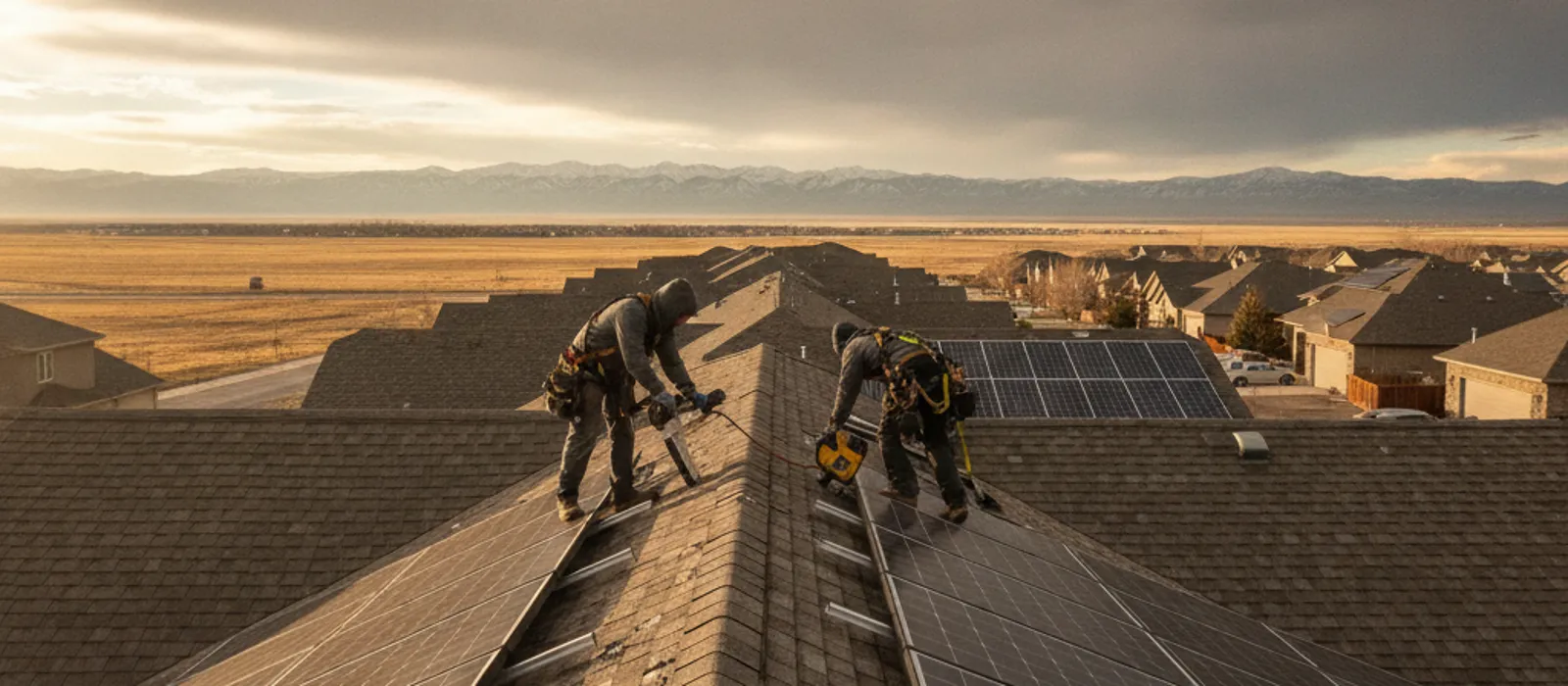
First is the panel removal itself. Each module gets disconnected, unbolted from the racking, and carried down. On a steep or two-story roof, this is slow, careful work with fall protection. Panels are heavier and more awkward than they look from the ground.
Second is the racking and mounting hardware. The rails come off, and then every mounting foot gets removed. This is the part most homeowners don’t think about. Each foot is lagged into a rafter through your roofing, and every one of those penetrations has to be properly sealed or patched. On a system with 20 panels, you might have 40 or more penetrations. Sloppy patching here is how you end up with slow leaks that show up two winters later.
Third is the electrical work. The system has to be safely de-energized, the conduit and wiring removed or capped, and the inverter and disconnects taken off the wall. If you have a utility interconnection agreement, the system should be formally retired with your utility so you’re not carrying a solar agreement on a house with no solar. Xcel Energy and most Northern Colorado utilities have a specific process for this.
Fourth is disposal. Panels don’t go in the trash. Some can be resold or donated if they still produce, but hail-damaged or degraded panels need to go to a recycler. The EPA has guidance on solar panel end-of-life handling, and Colorado has a growing number of recycling options, but hauling and recycling fees are a real line item on your quote.
A company that quotes you a suspiciously low number is usually skipping one of these four steps. Ask which one.
The Real Cost to Remove Solar Panels Permanently, Broken Down
Here’s how the numbers typically stack up for a full permanent removal in the Greeley area:
| Cost Item | Typical Range | What Affects It |
|---|---|---|
| Panel removal labor | $60 to $150 per panel | Roof pitch, height, access |
| Racking and mount removal | $400 to $900 | Number of mounting feet, roof type |
| Roof penetration sealing | $200 to $600 | Whether roof is being replaced anyway |
| Electrical decommissioning | $300 to $800 | Inverter type, conduit runs, utility paperwork |
| Hauling and disposal | $150 to $500 | Panel count, recycling vs. resale |
| Total, typical home | $1,500 to $6,000 | System size is the biggest driver |
A small 10-panel system on an easy single-story ranch might come in near the bottom of that range. A 30-panel system on a steep two-story with a long conduit run and dead panels headed to recycling will push toward the top.
Marcy in Fort Lupton is a good example of a middle-of-the-road job. The June hailstorm totaled her 12-panel array along with her roof. Her insurance paid for the roof, but the panels were 14 years old and she decided reinstalling them made no sense. Full removal, including capping the electrical and hauling the damaged panels to a recycler, came to $2,150. Her roofer then had a clean deck to work with, and she wasn’t paying to reinstall panels that were barely producing.
Compare that to Dale in Eaton, who had a 24-panel system he’d bought out of a lease years ago. Bigger system, steeper roof, and a string inverter setup with a long conduit run down the back of the house. His removal ran $3,400. Still well within the normal range, just a bigger job.
Removal vs. Detach and Reset: Don’t Pay for the Wrong Job
Here’s the part that surprises people. If you’re removing panels because you need a new roof, permanent removal is probably the wrong service, and the wrong price.
A solar detach and reset means we take the panels and racking down, your roofer replaces the roof, and then we put the same system back up and recommission it. You keep your solar production, your net metering agreement, and the value the system adds to your home. If you’re not sure how that process works, we walk through it step by step in what a solar detach and reset actually is.
Permanent removal makes sense in a few specific situations:
- Your panels are old or degraded and produce too little to justify reinstall labor
- Hail totaled the panels and insurance is paying for the roof but the array isn’t worth replacing
- You’re selling and a buyer or lender wants the system gone
- A leased system’s term ended and the leasing company abandoned the equipment
- You’re re-siting, going ground mount, or replacing the whole array with new equipment
If your panels still produce well and you plan to stay in the house, removing them for good usually costs you more over time than the removal itself. You lose the monthly production and you’d pay full price to go solar again later. The Department of Energy has a useful overview of what happens to photovoltaic systems at end of life if you’re weighing whether your array is truly done.
And if hail is what started this whole conversation, get the panels inspected before you decide they’re dead. Damage isn’t always visible from the ground, and sometimes it’s worse than it looks. Our guide to hail-damaged solar panel replacement costs covers how to tell the difference between panels worth saving and panels worth recycling.
Not sure which side of that line you’re on? Call (970) 286-3417 and describe your system. We do this all day and we’ll give you a straight answer, even when the answer is “don’t hire us for full removal.”
What Drives Permanent Solar Removal Cost Up or Down
Every quote we write starts with the same handful of questions. Here’s what moves the number.
Panel count and system size. The single biggest factor. Labor scales with panels, and so do disposal fees. A 10-panel job and a 28-panel job are different animals.
Roof pitch and height. A walkable single-story roof is fast. A 10/12 pitch two-story needs full fall protection, roof jacks, and more time per panel. That can add 30 to 50 percent to labor.
Whether the roof is being replaced anyway. This one can save you money. If your roofer is tearing off the roof right behind us, we don’t need to patch every penetration to a permanent finished standard, because that decking is coming off. If the roof is staying, every hole gets sealed properly, and that’s more labor.
Inverter and electrical layout. Microinverters mean more small components but simpler wiring. A string inverter with long conduit runs means more electrical teardown. Ground-mounted disconnects, sub-panels, and battery systems all add time.
What happens to the panels. Working panels that can be resold or donated sometimes offset a chunk of the disposal cost. Hail-shattered panels are pure disposal expense. Be wary of anyone who offers to “just take them to the dump” for cheap. Panels contain materials that shouldn’t be landfilled, and in some cases that disposal route isn’t even legal.
Lease and loan status. If the system is leased or has a UCC filing against it, the leasing company or lender has a say in what happens to the equipment. Sorting that out isn’t expensive, but it can add weeks to the timeline if you don’t start early.
One more honest note: quotes vary between companies for reasons that have nothing to do with your roof. Insurance, licensing, whether the crew includes a licensed electrician, and whether disposal is actually included all show up in the price. The cheapest quote is often the one missing something.
How to Keep Removal Costs Down Without Cutting Corners
There are a few legitimate ways to trim the bill.
Bundle it with your reroof. If removal is happening because of a roof replacement anyway, scheduling the removal to land right before tear-off saves the penetration-patching labor. This is the most common savings we see, often $300 to $500.
Ask about panel resale. If your panels are under 10 years old and undamaged, ask whether they have resale or donation value. It won’t make you rich, but it can knock the disposal line down to zero or better.
Handle the utility paperwork promptly. Retiring your interconnection agreement is usually free, but ignoring it can cost you later, especially at home sale time when a title company finds an active solar agreement on a house with no solar.
Get the electrical capped by a pro, full stop. This is the one place not to save money. A solar array is a live electrical system, and DC wiring from panels can carry lethal voltage even with the sun barely up. Homeowners can safely handle exactly none of the electrical decommissioning. If someone on a forum tells you to just pull the panels yourself and cut the wires, close the tab. The panel and racking removal itself is also genuinely dangerous work on most roofs, between the weight, the height, and the live wiring underneath.
That’s not a scare tactic to sell you labor. Take a look at our solar panel removal service in Greeley and you’ll see the crew, insurance, and electrical licensing that stand behind the work. That’s what you’re paying for.
Get a written scope, not a phone number. A real removal quote lists panel count, racking removal, penetration sealing, electrical decommissioning, disposal, and permits if required. A number scribbled on a card tells you nothing about what’s included. Free written estimates exist for a reason, and ours are genuinely free. Request one here.
One last local example. Tom owns a rental in Windsor with a 16-panel system the previous owner installed. Panels were fine, but the roof under them was toast after last summer’s hail and his insurance scope covered detach and reset. He’d called us for permanent removal, assuming that was his only option. The detach and reset came to $2,700 against roughly $2,900 for removal, and he kept a working solar array that helps him market the rental. The point isn’t that removal is wrong. The point is to price both options before you decide. If insurance is involved, our post on whether insurance covers solar detach and reset explains what adjusters will and won’t pay for.
When to Schedule Removal and How Long It Takes
Timing matters more than most people expect, especially mid-reroof.
A typical residential removal takes one day. Larger systems, steep roofs, or complicated electrical can stretch to two. The utility paperwork runs on its own clock, usually one to three weeks, and can happen in parallel.
If a roofer is involved, coordinate the schedule so removal lands a day or two before tear-off. Panels sitting in a garage for three weeks while a roofing crew waits on materials is fine. A roofing crew standing on your driveway waiting for a solar crew that’s booked out two weeks is not. In hail season around Weld and Larimer counties, both trades book up fast after a big storm, so call early.
If storm damage is forcing your hand and there’s active damage under the array, don’t wait on a normal schedule. A leaking roof under solar panels gets worse quietly, because the panels hide the damage from view. That’s what our 24/7 line is for.
Frequently Asked Questions
How much does it cost to remove solar panels permanently?
Most Northern Colorado homes fall between $1,500 and $6,000, with typical jobs around $2,000 to $3,500. The biggest factors are panel count, roof pitch and height, electrical complexity, and disposal. Get a written quote that itemizes removal, racking, penetration sealing, electrical decommissioning, and disposal so you can compare bids fairly.
Can I remove solar panels myself to save money?
The physical unbolting looks simple, but the system stays electrically live whenever there’s daylight, and DC voltage from an array can seriously hurt or kill you. You’re also working at height with 40-pound panels and voiding warranties in the process. Leave the electrical work to a licensed pro at minimum, and honestly, leave the whole job to a crew with fall protection and insurance.
Does removing solar panels damage the roof?
Done right, no. Every mounting foot leaves a penetration in the roof, and each one needs proper sealing or patching. If your roof is being replaced anyway, timing removal just before tear-off means those patches don’t need to be permanent. If the roof is staying, insist on a company that documents how each penetration was sealed.
Is it cheaper to remove panels or do a detach and reset?
Straight removal is usually somewhat cheaper up front, since there’s no reinstall labor. But if your panels still produce well, removal costs you the ongoing electric bill savings and the system’s value at resale. For a reroof with healthy panels, detach and reset almost always wins the long-term math. Price both before deciding.