
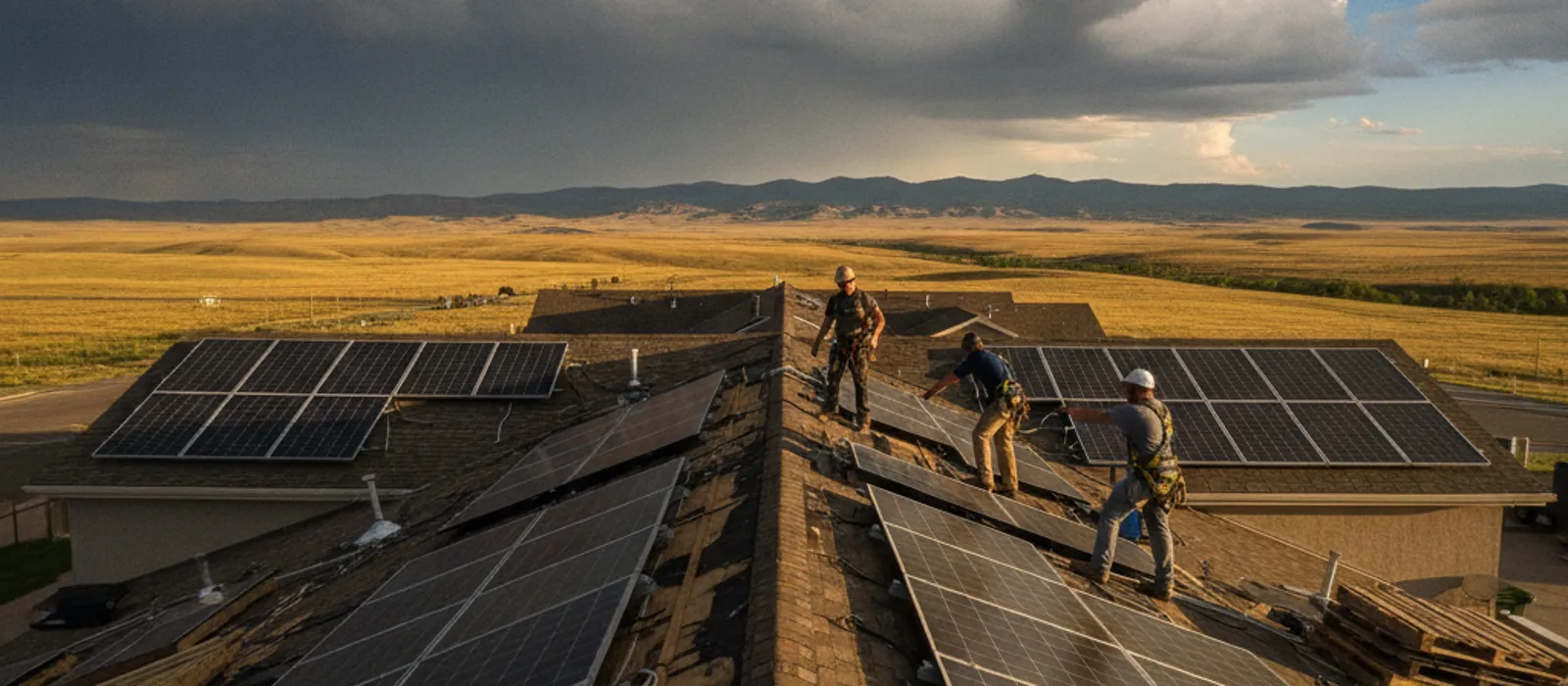
Your new roof looks great, the panels are back up, and then your first full power bill lands. It’s higher than it’s been in two years. If your solar panels are producing less after reinstall, you’re not imagining it, and you’re not alone. It’s one of the most common calls we get in Greeley in the weeks after a reroof.
Here’s the good news. Most production drops after a detach and reset trace back to a short list of causes, and the majority of them are fixable without buying new equipment. A missed breaker, a string that never got reconnected, a monitoring system that lost its brain during the outage. This article walks you through what to check yourself, what the numbers should look like, and where the line is between a homeowner check and a job for someone with a meter and a harness.
If your system’s been down or underperforming for weeks and you just want it handled, call us at (970) 286-3417. We do free written estimates, and diagnosing post-reinstall production problems is a big part of what we do.
First, Rule Out the Simple Explanations
Before you assume the reinstall crew broke something, check the boring stuff.
Is the system actually on? After a detach and reset, someone has to flip the AC disconnect, the solar breaker in your main panel, and often a DC disconnect at the inverter. If any one of those got left off, you’re producing nothing, not just less. We covered this full restart checklist in our post on why solar systems stay offline after a roof replacement, and it’s worth running through before anything else.
Are you comparing the right months? Solar output in Northern Colorado swings hard by season. A system that made 950 kWh in June might make 650 kWh in October, and that’s normal. Pull up your monitoring history and compare this month to the same month last year, not to last month. The Department of Energy has a plain-English explainer on what drives solar performance if you want the background.
Did anything change around the array? New trees leafing out, a neighbor’s addition, even a new chimney cap or satellite dish from the roofing job can throw shade on a panel. On string systems especially, shading one panel can drag down a whole row.
Was it smoky or snowy? Wildfire smoke can knock 10 to 25 percent off production for days at a time along the Front Range. A dusting of snow or a layer of construction dust from the reroof does the same. Take a quick look from the ground first.
If you’ve checked all four and the numbers are still low compared to the same month last year, keep reading. Now it’s worth looking at the reinstall itself.
Why Solar Panels Produce Less After a Reinstall
A detach and reset is more invasive than people think. Every panel comes off, every connector gets unplugged, rails often get repositioned, and the whole system sits dead for days while the roof goes on. Here’s what can go sideways in that process.
A string never got reconnected. Residential systems are usually wired in groups of panels called strings. If one string’s connectors didn’t get mated properly on the way back up, you lose that entire group. A 20-panel system with one dead 7-panel string loses about a third of its output, and the rest of the system runs fine, which is why people don’t always notice right away.
Connectors got mismatched or damaged. MC4-style connectors are supposed to click together firmly. A half-seated connector still passes power at first, then builds resistance, heats up, and degrades. This is also a fire risk, which is why it matters beyond the lost kilowatt-hours.
Panels went back in a different layout. If the crew changed the array layout to work around new vents or a different rail plan, some panels may now sit at a worse tilt or catch shade they didn’t before. Even a small layout change can cost 3 to 8 percent.
Optimizers or microinverters weren’t re-paired. Systems with SolarEdge optimizers or Enphase microinverters have electronics under each panel. If panels were shuffled, the monitoring map is now wrong, and in some cases units need to be re-paired to the system before they produce at full power.
A panel got cracked in handling. Panels can take a hit during removal, storage, or reinstall and still look fine from the ground. Internal micro cracks cut output slowly and unevenly. If your reset happened because of hail, some of that damage may predate the reinstall entirely. Our post on micro cracks in hail-damaged solar panels goes deep on how invisible damage shows up in production data.
Mark in Evans is a good example of the string problem. His 24-panel system went back up after a reroof last fall, and his monitoring showed production down about 30 percent against the prior year. When we opened it up, one string of 8 panels had a connector that was never fully seated behind the array. Twenty minutes of work, zero parts. Because the original reset was done under a workmanship warranty, his fix cost him $0. The 6 weeks of lost production before he called cost him roughly $110 in extra utility bills he couldn’t get back.
Check Your Inverter and Monitoring Before Anything Else
If the simple stuff checks out, your inverter and your monitoring app are where the real answers live. This part is safe for any homeowner.
Read the inverter status lights. Walk to your inverter, usually mounted in the garage or next to your meter, and look at the display or LEDs during daylight. Green usually means producing. Red, yellow, or a fault code means the inverter is telling you exactly what’s wrong. Write the code down before you call anyone. If your fault codes started after a storm rather than the reinstall, our guide to inverter errors after a storm covers the common ones.
Check per-panel data if you have it. Enphase and SolarEdge apps show output panel by panel. One dead panel in a sea of healthy ones points to a connector or a failed optimizer. A whole block of dead panels points to a string or wiring issue. Everything reading low by the same amount points to shading, soiling, or a metering problem.
Confirm the monitoring gateway reconnected. During a reroof, the monitoring gateway loses power and sometimes loses its Wi-Fi pairing. The system can be producing perfectly while the app reports zero. Before assuming a production problem, check whether your utility meter is actually spinning backward, or slowing down, on a sunny afternoon.
Compare against an objective baseline. NREL’s free PVWatts calculator estimates what a system your size should produce in your zip code, month by month. Punch in your system size and compare. If PVWatts says 780 kWh for August in Greeley and you made 500, you have a real gap worth chasing.
Denise in Windsor used exactly this approach. After a hail claim and reset, her app looked normal at a glance, but her PVWatts comparison showed she was running about 18 percent under expected, every single month. Per-panel data showed six panels reading consistently low. Testing confirmed micro crack damage from the hailstorm that caused the reroof in the first place. Her insurer covered six replacement panels on a supplement, about $4,800 in equipment and labor she’d have eaten herself if she hadn’t caught it inside her claim window.
Underperformance after a hail event isn’t just an annoyance, it can be a claim item. If your reset came out of a storm, get the production gap documented while the claim is still open. We handle that documentation as part of our solar hail damage service in Greeley, and we’re happy to look at your production data before you decide anything. Reach out through our contact form and send us a screenshot of your monitoring history.
What Diagnosing Low Production After a Reinstall Costs
Here’s what homeowners in Weld and Larimer counties typically see for post-reinstall production problems, from free to worst case.
| Problem found | Typical cost to fix | Notes |
|---|---|---|
| Breaker or disconnect left off | $0 | Homeowner can flip these safely |
| Monitoring gateway offline | $0 to $150 | Often a Wi-Fi re-pair; some installers charge a trip fee |
| Unseated or failed connector | $0 to $300 | Free if under the reset crew’s workmanship warranty |
| Dead string, wiring fault | $150 to $600 | Diagnostic plus repair, roof access required |
| Failed optimizer or microinverter | $200 to $500 per unit | Part often under manufacturer warranty, labor usually isn’t |
| Cracked or damaged panel replacement | $600 to $1,100 per panel | May be claimable if tied to hail or handling |
| Full system inspection and IV curve testing | $250 to $450 | Worth it when the cause isn’t obvious |
Two notes on this table. First, if your detach and reset was done recently, workmanship warranties commonly cover reconnection errors, so ask the company that did the reset before paying anyone. Second, costs stack when problems sit undiagnosed. A system running 25 percent low on a typical Greeley home is quietly costing $25 to $45 a month in higher utility bills, so a $300 diagnostic pays for itself fast.
Tom in Johnstown learned the stacking lesson the hard way. His production dropped after a reset and he decided to wait for spring to deal with it. By the time we got up there, a heat-damaged connector had taken out an optimizer too. What would’ve been a $200 connector fix in November became a $640 repair in April, plus about five months of reduced production he estimated at $160. Waiting is the most expensive option on this list.
When to Stop Troubleshooting and Call a Pro
Everything above the roofline is where homeowner troubleshooting ends.
You can safely check breakers, disconnects, inverter displays, and your monitoring app. You can compare numbers against PVWatts and look at the array through binoculars.
What you shouldn’t do is get on the roof, unplug connectors, open combiner boxes, or probe DC wiring. Residential solar strings run at 300 to 600 volts DC, and DC arcs don’t self-extinguish the way household AC faults do. A connector that looks fine can be carrying a fault. Add a steep Colorado roof and it’s just not a homeowner job.
Call a professional when:
- The inverter shows a fault code that mentions ground faults, arc faults, or insulation resistance. Stop there. These can indicate damaged wiring and are a genuine safety issue.
- Per-panel monitoring shows a dead panel, a dead string, or a scattered pattern of low performers.
- Production is more than 10 percent under your same-month history or your PVWatts baseline for two straight months.
- Your reset happened after hail and you’re still inside your insurance claim window. Time matters here.
- You smell anything burning near the inverter or see scorch marks anywhere. Shut the system down at the AC disconnect and call immediately.
If the company that did your reset is responsive, start with them, since reconnection errors should be on their warranty. If they’re not calling you back, or a roofer’s sub did the work and has moved on, that’s where we come in. Our detach and reset service in Greeley includes post-reset production verification, and we take diagnostic-only calls on systems other companies reinstalled. If you’re not sure what a proper detach and reset should have included in the first place, our overview of what solar detach and reset actually involves is a useful yardstick.
One phone call gets you a straight answer and a free written estimate. Call (970) 286-3417, or if it’s after hours and something smells hot or looks scorched, use the same number, since our emergency line runs 24/7 for storm and safety callouts.
How to Protect Yourself on the Next Reinstall
If you’re reading this before a reroof rather than after, a few habits prevent almost every problem in this article.
Screenshot your production history before the panels come down. Grab the last 12 months from your monitoring app. That baseline is your proof if output drops afterward, and it’s what an insurer or warranty department will ask for.
Get the reconnection scope in writing. A proper reset quote should include reconnecting all strings, re-pairing optimizers or microinverters, restoring monitoring, and verifying production before the crew leaves. If a bid doesn’t mention post-reset verification, ask why.
Insist on a commissioning check. The crew should show you the system producing, on the app or the inverter display, before they drive away. Not “it’ll kick on this afternoon.” Producing, now, with numbers.
Watch the app for the first two weeks. Compare daily output to the same dates last year. Catching a dead string in week one usually means a free warranty fix. Catching it in month four means an argument.
A reinstall done right gives you back the exact numbers you had before. Anything less deserves an explanation.
Frequently Asked Questions
How much production loss after a reinstall is normal?
Basically none. A correctly performed detach and reset returns your system to its previous output, adjusted for season and weather. If you’re more than 10 percent below the same month last year for two months running, something’s wrong. Small differences of 2 to 3 percent can come from minor layout changes or normal panel aging, but a double-digit gap isn’t the reinstall “settling in.”
Who pays to fix low production after a detach and reset?
It depends on the cause. Reconnection mistakes like unseated connectors or missed strings should fall under the reset company’s workmanship warranty at no cost to you. Failed optimizers or microinverters are often covered by manufacturer warranties, though labor may not be. Panel damage tied to the hailstorm that triggered your reroof can be a supplement on your insurance claim, which is why documenting the gap quickly matters.
Can my roofer diagnose why my solar is underperforming?
Usually not. Roofers are licensed for roofing, and diagnosing string voltage problems, optimizer faults, and inverter codes requires solar-specific tools and electrical knowledge. If a roofer’s crew handled your reset, ask who actually did the solar work, because that’s the party whose warranty applies. A solar contractor can test the system independently and put the findings in writing.
How long does it take to diagnose a production problem?
Most diagnostics take one site visit of 1 to 3 hours. We review your monitoring data, check the inverter, test string voltages, and inspect connectors and roof penetrations. Simple fixes like a connector or a breaker happen the same visit. Panel or optimizer replacements may need a second trip once parts arrive, typically within a week or two.