
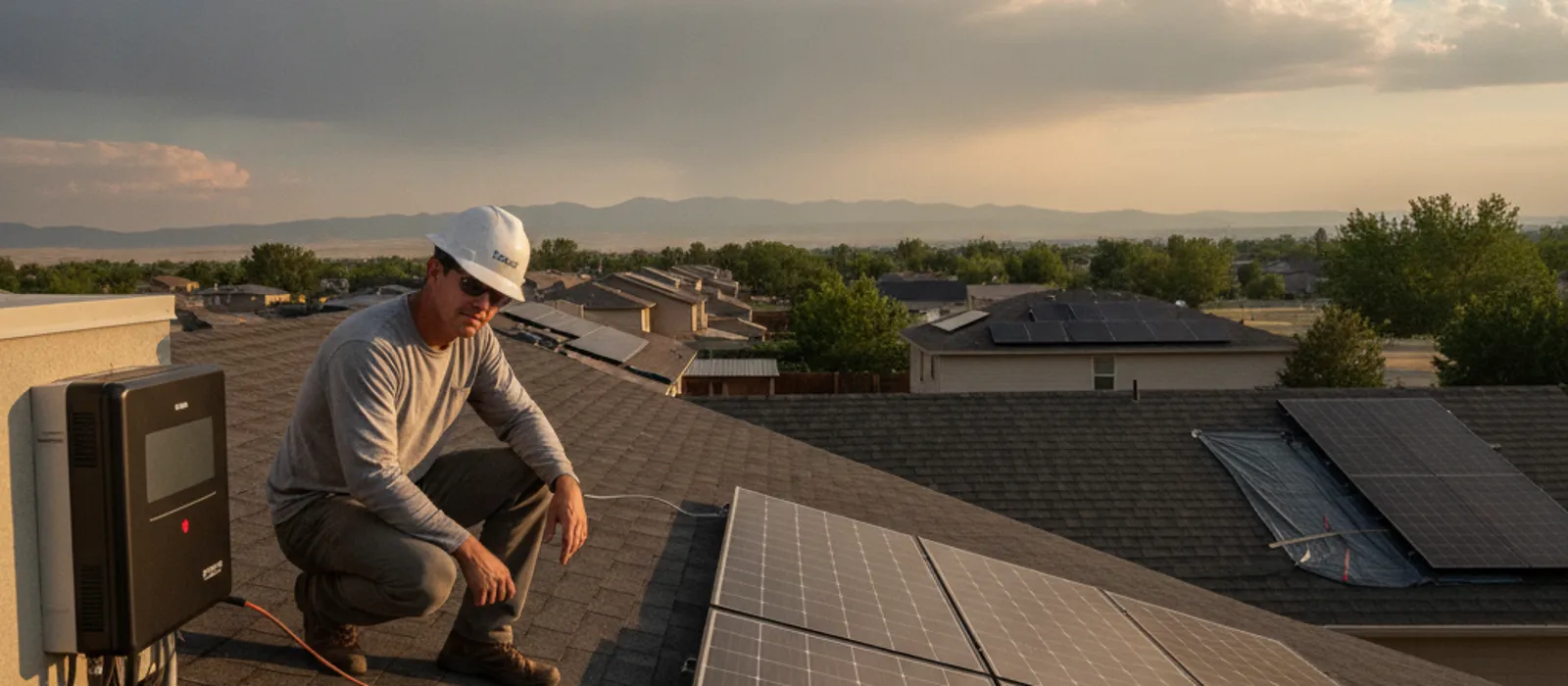
The hail quit an hour ago, the sun’s back out, and now your inverter is blinking red at you. If you’re staring at a solar inverter error after a storm and wondering whether it’s a $50 problem or a $5,000 problem, you’re in the right place.
Here’s the short version. Most inverter errors after a storm fall into one of three buckets: a nuisance trip that clears on its own, a wiring or connector problem that’s cheap to fix if you catch it early, and real hardware damage that belongs in your insurance claim. The trick is telling them apart before you either panic or, worse, ignore something that’s quietly getting more expensive.
We see this constantly in Greeley, Evans, Windsor, and the rest of Weld and Larimer counties. Northern Colorado sits in one of the most active hail corridors in the country, and inverters are often the first part of a solar system to announce that something upstream took a hit.
This guide walks through what the common error types mean, what you can safely check yourself, and where the line is between DIY and calling someone with a meter and a harness. If your system is dark and you’d rather just talk to a human, our storm line answers around the clock at (970) 286-3417.
Why Storms Knock Inverters Into Error Mode
Your inverter is the nervous system of your solar array. It converts DC power from the panels into AC power your house can use, and it constantly monitors voltage, current, resistance to ground, and the grid connection. When any of those readings drifts out of range, it shuts down and throws a code. That’s not a malfunction. That’s the inverter doing its job.
Storms give it plenty of reasons to trip:
- Grid outages and voltage swings. When Xcel or Poudre Valley REA has an outage, your inverter is required to disconnect for safety. Utility-scale storms often bring messy voltage on the way back too, which can trigger repeat grid faults.
- Moisture intrusion. Wind-driven rain and melting hail can push water into junction boxes, conduit penetrations, and connectors. Wet insulation lowers resistance to ground, and the inverter reads that as a ground fault or isolation error.
- Physical damage. Hail impacts can crack panels, and wind can flex racking enough to chafe or pull wiring. Damaged conductors show up as arc faults or ground faults.
- Surges. Nearby lightning doesn’t have to hit your roof to hurt you. Induced surges travel through the grid and through your array’s wiring, and inverters are full of sensitive electronics.
The U.S. Department of Energy has a plain-English explainer on what inverters do and why they’re so central to system safety, and it’s worth a skim: Solar Integration: Inverters and Grid Services Basics.
The key point for you: an error code is a symptom, not a diagnosis. The same red light can mean “the grid blinked” or “there’s energized wiring touching your racking.” That’s why the next two sections matter.
Common Inverter Error Codes After Hail or Wind
Every brand words its faults differently. SolarEdge, Enphase, SMA, Fronius, and Generac all have their own code lists, but almost everything you’ll see after a storm maps to one of the categories below.
| Error type | What it usually means | Storm connection | Typical fix cost |
|---|---|---|---|
| Grid fault / AC voltage or frequency | Utility power is out or unstable | Very common, clears itself | $0 |
| Ground fault (GFDI) | Current leaking to ground somewhere in the array | Moisture in a connector or damaged wire insulation | $250 to $1,500 |
| Isolation / insulation error | Low resistance between conductors and ground | Water intrusion, often dries out but shouldn’t be ignored | $0 to $1,200 |
| Arc fault (AFCI) | Electrical arcing detected on the DC side | Loose, corroded, or hail-damaged connectors | $250 to $900 |
| Low or zero production, no code | Panels damaged or string offline | Cracked cells, blown fuse, failed optimizer | $300 to $2,500+ |
| Dead inverter, no display | Internal electronics failed | Surge damage from nearby lightning | $2,000 to $4,500 replaced |
A few notes on reading that table honestly. Grid faults are the happy ending. If the storm knocked power out in your neighborhood, your inverter will sit in a waiting state and reconnect on its own, usually within five minutes of stable grid power. No charge, no visit, no drama.
Ground faults and arc faults are the ones to respect. Both mean electricity is going somewhere it shouldn’t, and both can involve fire risk if the underlying cause is damaged wiring rather than a little rainwater. An isolation error that appears the morning after a storm and clears by afternoon was probably moisture. One that comes back every damp morning means water is getting somewhere it shouldn’t, and that’s often a roof penetration problem too. If you’re seeing that pattern, read our post on roof leaks under solar panels, because the two issues frequently travel together.
What’s Safe to Check Yourself (and Where to Stop)
You don’t need us for everything. Here’s the homeowner-safe checklist, in order:
- Confirm the grid is on. If your neighbors are dark, your inverter is just waiting. Check your utility’s outage map before touching anything.
- Read the actual code. Take a photo of the display or open your monitoring app. Write down the exact fault name and when it first appeared. This saves real money later, because it gives a tech a starting point and gives your adjuster a timestamp.
- Check your monitoring history. Apps like SolarEdge and Enphase show per-panel production. If one panel or one string flatlined at the exact time of the storm, you’ve basically diagnosed it already.
- Do one restart, the right way. Turn off the AC breaker for the solar system, turn the DC disconnect off, wait five minutes, then reverse the order: DC on, then AC on. One time. If the code comes back, stop restarting. Repeatedly resetting an arc fault or ground fault is like clearing a smoke alarm without looking for the fire.
- Look from the ground only. Binoculars or a phone zoom from the yard. Look for shattered glass, panels sitting crooked, or wiring hanging below the array. Do not get on the roof, and absolutely do not open the inverter, junction boxes, or touch array wiring. The DC side of a solar array is energized whenever the sun is up, disconnect or not, and it carries enough voltage to kill.
That’s the whole safe list. Ground faults, arc faults, isolation errors that persist, physical damage, or a dead inverter all mean it’s time for a professional with the right meters and fall protection. If any of those describe your system right now, request a free written estimate and we’ll get eyes on it, or call (970) 286-3417 if water or burning smells are involved. Our emergency solar service in Greeley runs 24/7 during storm season for exactly this.
The National Weather Service’s guidance on lightning safety is also blunt on this point: after electrical storms, leave energized equipment to people trained on it.
When an Inverter Error After a Storm Means Real Damage
Three quick stories from our service area, because the patterns repeat.
Marcus in Evans had a ground fault code show up two days after a June hailstorm. His system had actually kept producing, so he almost ignored it. When we opened things up, water had gotten past a hail-cracked conduit fitting on the roof and soaked a junction box, corroding the wiring inside. Because his roof was already being replaced under a hail claim, we documented the damage, his roofer’s supplement covered the electrical repair, and the wiring fix added about $1,100 to the scope instead of coming out of his pocket. Caught three months later, that same corrosion could have meant a burned connection and a much bigger bill.
Renee in Windsor called us convinced her inverter was dead. Arc fault code, wouldn’t stay reset, and an online forum had her budgeting $3,000 for a replacement. The actual culprit: two scorched MC4 connectors on a string where wind had flexed the wiring against a racking rail. Total repair, including the diagnostic visit, came to $475. She’d have overpaid by thousands if she’d replaced the inverter on a guess, which is exactly why diagnosis comes before parts.
Dale in Eaton wasn’t so lucky. A close lightning strike during a July storm sent a surge through the neighborhood, and his 10-year-old string inverter never powered on again. Replacement ran $2,850 installed. The good news: his homeowner’s policy treated it like any other storm-damaged equipment, and after his $1,500 deductible he was out of pocket less than half that. His photo of the dead display, timestamped the morning after the storm, made the claim straightforward.
The common thread: the error code was the visible tip of something physical. If your storm also left dents, shattered glass, or dark panels in your monitoring app, look at our guide to the signs of hail damage on solar panels, because panel damage and inverter faults usually get claimed together.
What Inverter Problems Cost to Fix in Northern Colorado
Rough numbers we see across Greeley, Johnstown, Firestone, and Fort Lupton, so you can sanity-check any quote:
- Diagnostic visit: usually $150 to $300, often credited toward the repair.
- Connector or wiring repairs: $250 to $900 for typical arc fault and ground fault fixes.
- Optimizer or microinverter swap: $300 to $600 per unit if out of warranty, often just labor if the part’s covered.
- String inverter replacement: $2,000 to $4,500 installed, depending on size and brand.
- Full detach and reset with repairs: if your roof is being replaced anyway, wiring and connector repairs get rolled into the solar detach and reset scope, which is the cheapest time to fix them since the labor is already on the roof.
Two cost realities worth knowing. First, most inverters carry 10 to 12 year warranties, and many failures inside that window cost you labor only, so dig out your paperwork before authorizing a replacement. Second, storm-caused inverter damage is generally claimable on a homeowner’s policy alongside roof and panel damage. Adjusters see inverters get missed all the time because nobody put the error code in the file. Your photo and timestamp are worth real money. We cover how the claim side works in does insurance cover solar detach and reset.
Getting Ahead of It Before the Next Storm
You can’t hail-proof an inverter, but you can make the next storm cheaper:
- Know your baseline. Glance at your monitoring app monthly so you’ll recognize “less than normal” quickly. Slow production losses from storm damage are easy to miss until the power bill jumps.
- Photograph your system now. Panels, inverter display, serial numbers. Before-and-after photos settle claim arguments fast.
- Ask about surge protection. A DC and AC surge protective device runs a few hundred dollars installed and is the single best defense against the kind of failure Dale had.
- Fold repairs into your reroof. If a storm damaged your roof badly enough to replace it, the detach and reset is the moment to fix every marginal connector and chafed wire while the array is off the roof.
If a storm just rolled through and your inverter’s throwing a code, don’t sit on it. A ten-minute phone call sorts nuisance trips from real problems, and the written estimate costs you nothing. Call (970) 286-3417 or reach us here, and we’ll tell you straight if it’s something you can just leave alone.
Frequently Asked Questions
Will my inverter error clear on its own after a storm?
If it’s a grid fault caused by a power outage, yes. The inverter reconnects automatically a few minutes after stable utility power returns. Ground faults, arc faults, and persistent isolation errors don’t fix themselves and shouldn’t be reset repeatedly, because the underlying cause is still there.
Is it safe to reset my inverter myself?
One properly sequenced restart is fine: AC breaker off, DC disconnect off, wait five minutes, then DC on and AC on. If the same code returns, stop and call a professional. Repeated resets on an arc fault or ground fault can mask a genuine fire hazard.
Does homeowner’s insurance cover a storm-damaged inverter?
Usually, yes. An inverter damaged by hail, wind, or a lightning surge is typically covered under the same claim as roof and panel damage, minus your deductible. Document the error code with a timestamped photo and get a written diagnosis, since adjusters need cause-of-loss evidence to include it in the scope.
My inverter shows an error but my panels look fine. Can panels still be damaged?
Yes. Hail can cause micro-cracks and internal cell damage that’s invisible from the ground but shows up as ground faults, arc faults, or falling production. Check per-panel data in your monitoring app, and have a pro inspect anything suspicious before the claim window on your policy closes.